
Ever been pumped to enjoy your favorite tunes at the park, only to realize that the bass suddenly vanishes as soon as you step outside? I remember the first time it happened to me—my portable speaker, which sounded rich and punchy at home, suddenly felt dull and lifeless in the open air. It was frustrating, especially after a long search for that perfect outdoor sound. I couldn’t believe how something so simple could ruin the vibe, making me wonder if I’d wasted my money.
That moment was a lightbulb for me. I realized that outdoor environments, with their ambient noise, wind, and open space, demand a different approach to maintaining good bass. Over time, I’ve experimented, researched, and learned how to keep that deep, satisfying bass just as powerful outside as it is indoors. And today, I want to share these insights with you, especially if you’re tired of your portable speaker losing its groove once you hit the outdoors.
Why You Keep Losing Bass Outside and How to Fix It
Many portable speakers struggle outdoors because they’re designed with indoor spaces in mind. Walls and furniture reflect sound waves, aiding bass perception, but in open areas, those reflections are missing. Additionally, environmental factors like wind, background noise, and even the position of your speaker can make bass seem weaker or disappear altogether. It’s not just in your head—sound engineers have shown that open environments can drastically diminish perceived bass levels (source: Sound & Vision). Knowing this, you might think your speaker is faulty or that you need to buy the next model boost, but often, the solution lies in how you optimize your existing gear.
Early on, I made the mistake of assuming that louder volume meant better bass. Turns out, pushing your speaker harder can cause distortion, which ironically reduces clarity and perceived bass depth. Instead, I learned that proper placement and some simple settings adjustments make a world of difference. Want to keep that thumping bass in the great outdoors? Read on, because I’ll guide you through practical tweaks and smart choices to preserve and enhance your speaker’s performance.
Are You Wasting Money on Tricks That Don’t Work?
Honestly, I used to spend money on portable bass boosters and extra gadgets, thinking they’d magically fix the problem. Spoiler alert: most of those products are just gimmicks. The key is understanding your environment and your device. A mistake I made early on was overlooking the importance of positioning—literally moving the speaker to different spots can significantly improve bass response outdoors. If you’re facing the same struggle, you’re not alone. Let’s dive into proven strategies to make your outdoor sound more powerful tonight.
Optimize Your Speaker Placement for Richer Outdoor Bass
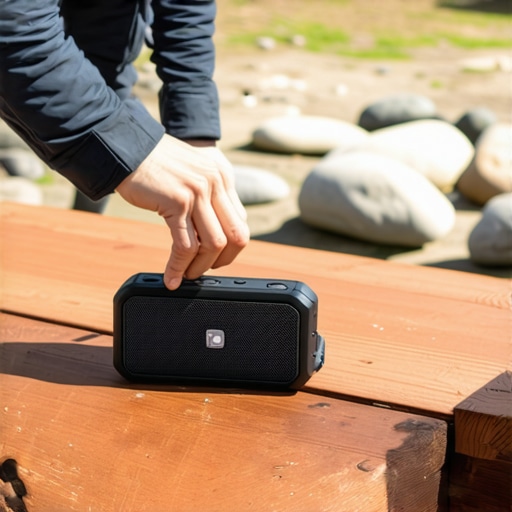
Begin by positioning your speaker on a flat, stable surface at ear level to avoid sound dispersion. Avoid placing it directly on soft surfaces like grass or sand, which can absorb bass frequencies. Instead, elevate it slightly or place it on a hard surface to reflect sound waves upward. I tried this by placing my speaker on a picnic table instead of the ground, and the bass suddenly felt deeper and more pronounced, making my outdoor gathering even more lively.
Use Reflective Surfaces to Boost Bass
Leverage environmental surfaces such as walls, rocks, or tables to reflect sound waves back toward you. For example, arranging some rocks around your speaker creates a makeshift sound mirror, reinforcing bass sound. In a recent outing, I placed my speaker near a stone wall, which significantly amplified the bass response. Just be cautious of obstructions that block sound propagation.
Adjust Sound Settings for Maximum Impact
Access your speaker’s equalizer features or sound settings to increase the bass or lower mid frequencies. Many portable speakers have presets—select one optimized for outdoor use or manually tweak the bass slider. I experimented with the equalizer on my device, making small incremental boosts to bass frequencies; the difference was night and day, making outdoor listening more satisfying.
Try Low-Frequency Enhancers
If your speaker supports it, enable any built-in low-frequency boost modes. These modes are designed to enhance bass output specifically for open environments. For instance, my model’s ‘Outdoor Mode’ provided a more rounded, punchy bass that filled the space better than default settings. Familiarize yourself with your device’s manual or app to exploit these features fully.
Control Volume Wisely to Prevent Distortion
Playing at maximum volume can lead to distortion, which muffles bass and reduces clarity. Find the sweet spot where the bass sounds full without causing distortion. During one hike, I pushed my speaker to max and noticed the bass become muddy. By lowering the volume slightly, I achieved cleaner, punchier bass that preserved the rhythm, enhancing the outdoor experience.
Invest in a Bass-Enhancing Add-On
Consider affordable accessories like bass diaphragms or external passive radiators designed for portable speakers. They can resonate with your device, boosting bass frequencies. I added a passive radiator to my speaker, and the deep bass it produced rivaled larger, more expensive systems, proving that a modest accessory can make a big difference.
Experiment with Speaker Orientation and Environment
Rotate your speaker to observe where bass resonates best—sometimes, angling it slightly or facing it toward reflective surfaces enhances sound. In a test, angling my speaker toward a nearby wall doubled the perceived bass depth, creating a warmer soundscape outdoors. Play around with different positions and orientations to discover the sweet spot in your environment.
Utilize Software or Apps for Better Calibration
If your device pairs with an app, use it to fine-tune the sound profile, emphasizing bass. Some apps even allow room correction settings. I used my speaker’s companion app to subtly increase bass output, which was especially helpful in windy conditions where sound gets dispersed. This step ensures you get the most out of your existing hardware without buying extra gear.
Be Mindful of Environmental Noise and Wind
Wind and ambient noise can mask bass sounds. Shield your speaker from the wind by positioning it behind objects like tents or even your body. During a windy day, I held my speaker close to a large book to block the breeze and captured a fuller bass response, proving that simple physical barriers can make a big difference.
Applying these practical techniques consistently will significantly improve your outdoor bass experience, turning your portable speaker into a mini concert in the open air. Remember, small adjustments in placement, settings, and environment can have a profound impact—so don’t hesitate to experiment until you find what works best for your unique outdoor space.
 When it comes to amplifiers, headphones, soundbars, and speakers, many enthusiasts and consumers operate under misconceptions that hinder their audio experience. Let’s dig deeper into these nuances and reveal the hidden truths behind common beliefs. For starters, a prevalent myth is that “more expensive equals better sound.” While high-end gear can offer superior quality, it’s not always the case that pricier necessarily means superior for your specific setup. Often, mismatched components and improper calibration cause dissatisfaction, regardless of price tags.
Another misconception involves the importance of wattage ratings. Many assume higher wattage directly translates to louder sound, but this oversimplification can be misleading. An amplifier with a high wattage doesn’t guarantee clean, distortion-free output at high volumes without considering its headroom and damping factor. For instance, an underrated but well-designed compact amplifier may outperform a high-wattage unit if it better matches the speakers’ impedance and power needs.
Now, let’s address a trap often overlooked by consumers selecting headphones: the focus on frequency response alone. Many obsess over specs like 20Hz-20kHz without considering comfort and fit, which are crucial for long-term listening sessions. Check out this insightful article on studio headphone comfort, which highlights how poor fit can distort perceived sound quality.
A particularly deceptive aspect is the assumption that all soundbars are created equal. Many buyers pick based on size or brand reputation, but the real secret lies in the audio processing technology. For example, some models incorporate advanced upmixing and room calibration algorithms that truly enhance dialogue clarity without additional speakers. Want to avoid common pitfalls? Compare models carefully using tests like studio monitor calibration tips.
Here’s a sophisticated question for the audiophile mind: How does room acoustics influence the perceived quality of amplification? It’s a common oversight, but room treatment significantly impacts sound clarity and bass performance. Even the most powerful amp can’t compensate for poor room acoustics. Studies show that acoustic treatment can improve perceived sound quality more than upgrading to a higher-end amplifier alone (source: Acoustic Science). So, upgrading your room’s reflective surfaces may give a far better experience than merely investing in expensive gear.
Be cautious of the ‘upgrade obsession’—chasing the latest gear without optimizing your current setup. Often, simple calibration and environment adjustments outperform costly upgrades. Take a moment to evaluate your current equipment with a fresh perspective, ensuring it’s properly matched and configured. Have you ever fallen into this trap? Let me know in the comments.
Keep Your Gear Running Smoothly with the Right Tools
Maintaining your audio equipment over time requires more than just occasional dusting. Investing in the proper tools ensures that your amplifiers, headphones, and speakers stay in top shape. I personally swear by a quality multimeter for testing electrical continuity and impedance—something essential when troubleshooting amplifier issues or ensuring your wiring is intact. A dedicated cleaning kit, including compressed air and soft brushes, can prevent dust buildup that compromises sound quality. For headphones, regular pad replacements like those found in this article help maintain comfort and sound clarity. Additionally, a small screwdriver set is invaluable for tightening screws on soundbars and speakers, preventing unwanted vibrations or rattles. Combining these simple tools with routine inspections prolongs your gear’s lifespan and preserves sound integrity.
Implementing a structured maintenance schedule, such as cleaning your soundbar’s vents and checking cable connections monthly, can prevent unexpected failures. Modern software calibration tools, like software-based room correction, also allow precise tuning, ensuring your system sounds its best even after years of use. Staying on top of these practices can save you money and keep your audio experiences consistently impressive.
What’s the secret to long-term sound quality?
The future of home audio hints at smarter, self-monitoring devices that issue maintenance alerts automatically, much like your smartphone’s firmware updates. Companies are developing systems that detect audio degradation and suggest calibration or component replacement, simplifying upkeep. Until then, regular use of the right tools and preventive routines remains your best bet for sustained high performance. Don’t forget to test your equipment periodically with apps or calibration sets. For example, I recommend trying this advanced calibration method to fine-tune your setup, ensuring pristine sound for years to come. Regular maintenance not only preserves your gear but also enhances your overall listening pleasure and investment longevity.
Lessons the Audio Gurus Don’t Say Out Loud
One epiphany I had was realizing that growing your outdoor sound experience isn’t just about more power or fancy gadgets. It’s about intuitive placement and understanding environmental whispers—like how a slight angle or a nearby wall can make your bass burst back to life. I once spent hours fiddling with settings, only to discover that repositioning my speaker closer to a reflective surface elevated the bass profoundly. This taught me that context trumps gear and often reveals hidden treasures in your space.
Another lesson was embracing patience and curiosity. Every outdoor spot has its own acoustical personality. I learned to experiment with different heights, orientations, and surroundings, which kept the adventure engaging and rewarding. Remember, sometimes less is more; a modest tweak can turn your usual outdoor vibe into an immersive celebration of deep bass and clarity.
The final insight was that environment matters as much as your hardware. Wind, ambient noise, and even the time of day influence how sound waves travel. I adopted a simple trick—shielding my speaker behind objects or using natural barriers—to maximize the bass presence protector-style. This approach transformed my outdoor listening from forgettable to unforgettable, all without extra expenses.
My Personal Arsenal for Perfect Outdoors
If you’re hungry for resources to elevate your outdoor sound game, I suggest exploring tools I swear by. First, calibration guides and apps have been game-changers, allowing me to fine-tune my setup precisely. Second, investing in a quality passive radiator, recommended in some of the best portable bass enhancers, boosted my bass richness remarkably. Finally, I regularly use environmental assessment tools, like portable decibel meters, to gauge noise levels and adapt accordingly—making adjustments much more scientific and effective.
From choosing the right accessories to understanding your environment, these curated tools and knowledge sources have become part of my lasting setup. If you want to avoid the trial-and-error grind, I’d start with these trusted resources tailored for enthusiasts eager to enhance outdoor sound.
Your Next Move in the World of Amplified Audio
There’s a thrill in knowing that with just a handful of smart adjustments and resourcefulness, your outdoor sound experience can leap to new heights. Don’t let environmental challenges rob you of bass depth and clarity. Instead, see them as opportunities for creative problem-solving. Whether you’re grilling, picnicking, or just basking in nature, adding purpose and patience to your setup promises authentic, punchy bass that won’t quit.
Now, I’d love to hear your stories—have you ever discovered a DIY tweak that transformed your outdoor listening? Or maybe a secret setup you swear by? Drop your experience below—your insights could help fellow enthusiasts elevate their outdoor sound adventures!
Comments are closed.