
I was halfway through a pristine pressing of ‘Rumours’ when Stevie Nicks suddenly sounded like she’d had one too many espressos, followed immediately by a drowsy, pitch-slurring drawl that made my skin crawl. There is nothing—and I mean nothing—more jarring than a turntable that can’t keep its pace. You’re sitting there, trying to relax, and suddenly the tempo starts wandering like a lost tourist. I remember early on in my journey, I actually thought my ears were playing tricks on me. I even made the rookie mistake of thinking a little bit of household oil in the spindle would solve everything; spoiler alert, it just made a massive mess and didn’t fix a thing. If you’re dealing with a platter that speeds up and slows down mid-track, you aren’t crazy, and your records aren’t possessed. We are going to get to the bottom of this drift today so you can get back to the music. Have you ever felt that sudden panic when a familiar song just sounds… ‘off’?
Your Turntable Shouldn’t Sound Like a Failing Tape Deck
Working with analog gear is a labor of love, but it comes with quirks that digital listeners never have to face. When your RPMs start fluctuating, it ruins the soundstage and kills the vibe. Most people assume the motor is burnt out, but often it is just a matter of maintenance. Much like why your vinyl records skip when you walk near the turntable, speed issues are usually physical and environmental. I spent years chasing ‘perfect’ sound only to realize that a stretched belt or a dirty pulley was the culprit 90% of the time. You don’t necessarily need a new deck; you just need to know where the friction is happening. According to audio engineering experts at SoundStage!, even a 1% variation in speed can be audible to the human ear as a pitch shift, which explains why that slight wobble feels so distracting. Before you start tearing things apart, make sure you properly ground your turntable to rule out any electronic interference that might be messing with your control board’s stability.
Is my motor actually dying or is it something cheaper?
It’s the question that keeps us up at night. Motors are expensive, but belts, pulleys, and basic lubrication are cheap. If you’ve been hunting for high quality vinyl records at thrift shops, you owe it to your collection to ensure the player isn’t dragging its feet. We are going to look at the belt tension, the power supply consistency, and the health of your spindle bearing to see where the drag is coming from.
Clean the Belt Before You Blame the Motor
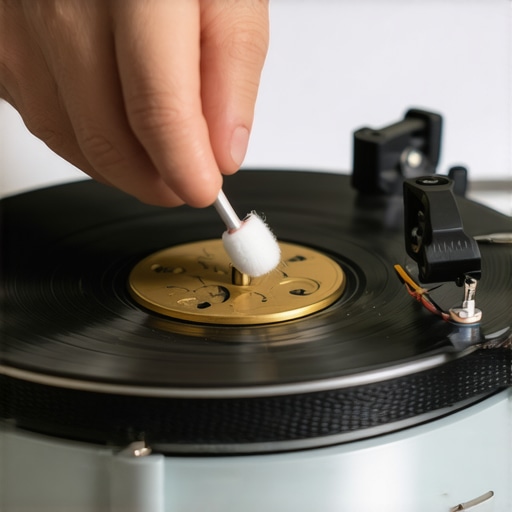
The most common cause of speed drift is simply a lack of friction where you need it most. Over time, skin oils, dust, and microscopic rubber debris build up on the drive belt and the motor pulley. This causes the belt to slip momentarily, leading to that nauseating pitch-shift. Take the belt off and soak it in a bowl of lukewarm water with a tiny drop of dish soap. While that is drying, use a cotton swab dipped in high-percentage isopropyl alcohol to clean the motor pulley. I once spent three hours recalibrating a vintage Pioneer only to realize the pulley was caked in black gunk from a disintegrated belt. Once I cleaned the metal, the speed locked in instantly. If you are also dealing with other gear issues, like how to fix the crackling noise when you turn your amp volume, keep that contact cleaner handy because grime is the enemy of all analog signals.
Check the Tension of Your Drive Belt
If cleaning doesn’t work, the belt might be stretched. Think of it like a rubber band that has lost its snap; it cannot grip the platter firmly enough to maintain a constant 33.3 RPM. You can test this by watching the belt as the platter starts. If it wobbles or takes more than three seconds to reach full speed, it is toast. Much like why your high-res audio stream keeps buffering on Wi-Fi, a lack of consistent torque ruins the experience. Replacing a belt is cheap—usually under twenty dollars—and it is the single most effective way to stabilize an old deck. I keep a spare for every table I own because you never know when one will finally give up the ghost and leave you with a warbling mess mid-album.
Oil the Bearing to Kill the Drag
The platter sits on a spindle that rests in a bearing well. If that factory grease has turned into peanut butter over the last thirty years, the motor has to work twice as hard to spin the weight of the platter. This extra load causes the motor to fluctuate as it fights the resistance. You only need two drops of specialized synthetic sewing machine oil or turntable oil. Do not use WD-40 or heavy motor oil; I learned that the hard way when I seized up a beautiful Technics by using the wrong weight. This is a precision instrument, not a lawnmower. If you have been lucky enough to find the $5 thrift store find that fixed my muddy guitar amp, you know that a little bit of the right chemical at the right time is worth its weight in gold for maintaining vintage equipment.
Adjust the Internal Speed Pots
If the mechanics are perfect but the speed is still wrong, the electronics are likely drift-prone. Most turntables have small adjustment screws (potentiometers) hidden underneath or inside the casing. You will need a tiny flathead screwdriver and a strobe disc to see the results in real-time. These pots control the voltage going to the motor. Turning them a fraction of a millimeter can bring a drifting motor back to life. It is a delicate process, but once you see those strobe lines stand still, you will know you have won the battle against the drift.
While we have covered the mechanical basics, I see so many enthusiasts fall for the expensive cable trap when their speed starts to wobble. There is a common myth that swapping out your RCA leads or getting gold-tipped everything will somehow stabilize the signal. In reality, why expensive speaker cables are mostly a marketing trick applies here too; your cables will not fix a motor that isn’t getting consistent voltage. The signal path and the power path are two different beasts. If you are chasing pure sound, you might think the truth about gold plated audio connectors for home stereos is your ticket to stability, but they will not touch the RPM fluctuations. The Oops factor often comes from people neglecting the power supply. Those cheap external power bricks degrade over time, and a dying capacitor inside can cause the voltage to sag and surge. Most people blame the turntable motor and scrap a perfectly good vintage deck when they really just needed a fifteen-dollar power replacement.
Can my motor controller actually learn the wrong speed?
Some high-end direct drive decks use quartz-locking mechanisms that are incredibly precise, but they can still fail if the feedback loop is interrupted. According to research published by the Audio Engineering Society (AES), even micro-variations in the mains frequency can affect older AC motors that do not have internal regulation. This is why why your phono preamp needs to be far away from the power amp is such critical advice—not just for noise, but to avoid magnetic interference that can mess with the sensitive control boards in your deck. If you are hunting for deals and finding legitimate high end gear at local thrift stores, always check the strobe window. If the dots are dancing, the fix might be as simple as a contact cleaner spray on the pitch slider. Don’t be the person who buys a five-hundred-dollar audiophile power cord to fix a mechanical drift. It is about precision, not price tags.  One nuance that beginners miss is the difference between speed accuracy and speed stability, commonly known as wow and flutter. You can have a deck that spins exactly at 33.3 RPM but still sounds wavy because the momentum is inconsistent. If you have ever wondered the real performance benefit of using balanced XLR cables, you will know that noise rejection is one thing, but mechanical noise from a cheap motor is another entirely. Do not try to hack your platter weight by adding heavy mats without checking if your bearing can handle the load. I have seen people ruin beautiful equipment because they thought a heavier platter would fix the drift, only to burn out the motor. Have you ever fallen into this trap of over-spending on cables to fix a mechanical problem? Let me know in the comments.
It’s not just about the tools you own; it’s about the habits you build. I’ve seen enthusiasts spend thousands on a high-end deck only to let the drive belt rot into a sticky mess. To keep your speed locked in, you need a dedicated maintenance kit. I always keep a digital stylus pressure gauge, a carbon fiber brush, and a high-quality strobe disc within arm’s reach. If you are serious about precision, the *RPM* smartphone app is a great modern hack; just place your phone centered on the spindle and it uses the gyroscope to give you a real-time readout. In the technical documentation provided by Rega Research for their Planar series, they emphasize that a drive belt’s elasticity is a consumable part of the system’s timing—it isn’t meant to last forever, and even environmental humidity can change how it grips the pulley.
Stop Guessing and Start Measuring with a Strobe Disc
A strobe disc is the only way to be 100% sure your eyes aren’t playing tricks on you. You place the disc on the platter, turn on a fluorescent or LED light, and watch the bars. If they appear to move forward, you’re fast; backward, and you’re slow. If you are finding legitimate high end gear at local thrift stores, this is the first test you should run. I’ve passed on several ‘bargain’ decks because the strobe revealed a motor that was hunting for its speed like a nervous heart. It’s also worth noting that the best way to test a used receiver before you buy it involves checking for stable power delivery, as a sagging power supply in an old integrated amp can actually cause your turntable’s external motor controller to freak out.

Why Your Living Room Floor is Killing the Vibe
Mechanical feedback is the silent killer of speed stability. If your floorboards flex when you walk, that energy travels up the rack and into the platter. The motor has to fight that micro-vibration, which manifests as ‘flutter.’ This is essentially the same physical principle behind why your vinyl records skip when you walk near the turntable. I personally solved my drift issues by moving my deck to a dedicated wall-mounted shelf. By decoupled the player from the floor, the motor load became consistent, and the pitch stayed rock solid. If your setup is getting pushed too hard, keep an eye on your amp too; why your amplifier gets hot enough to burn your hand is often a sign of the same poor ventilation or environmental stress that ruins turntables.
How do I keep my turntable spinning at the right speed for decades?
Consistency is your best friend. Clean the belt every six months with isopropyl alcohol and a lint-free cloth. Re-oil the main spindle bearing every two years using only two drops of synthetic oil. I predict we are moving toward a world where AI-assisted motor controllers will monitor the exact resistance of the stylus in the groove to micro-adjust voltage thousands of times per second, effectively ending the era of manual strobe tuning. For now, the best thing you can do is keep the dust away and ensure your belt is fresh. My big tip for today: go download a free strobe disc template, print it out, and check your speed right now. You might be surprised to find you’ve been listening to a ‘chipmunk’ version of your favorite albums for months without even realizing it.
Lessons from a Decade of Warped Audio
I have spent thousands of hours and probably too many late nights troubleshooting motor drift, and I have had some major lightbulb moments along the way. First, I realized that ‘budget’ belts are rarely a bargain; they often have microscopic variations in thickness that introduce a weird pulsing sound called flutter. Always buy the manufacturer-spec belt if you can find it. Second, don’t be afraid to poke around. A lot of people are terrified of opening their decks, but as long as you are gentle, that is where the real fixes happen. Third, check your power source. Before you dive into the motor, make sure you know the best way to test a used receiver before you buy it if you are building out a full vintage system, because sometimes the speed issues are caused by dirty power delivery from an old amp rather than the turntable itself.
My Essential Toolkit for Perfect Pitch
You do not need a professional laboratory to get your RPMs right. My essential kit includes a strobe disc (you can print these for free online!), a bottle of high-purity isopropyl alcohol for cleaning pulleys, and a simple RPM app on my phone to get a digital reading. If you are constantly finding legitimate high end gear at local thrift stores, having these tools ready to go is a lifesaver. I also recommend keeping a small can of electronic contact cleaner nearby. If you ever need to how to fix the crackling noise when you turn your amp volume, that same spray can often clean the internal speed potentiometers on your turntable to stop electronic drift in its tracks. I trust these tools because they provide immediate, visible feedback that takes the guesswork out of maintenance.
Take Back the Rhythm of Your Music
At the end of the day, vinyl is about the connection to the music, and nothing breaks that bond faster than a song that sounds out of tune. Fixing your **turntable speed issues** is not just about technical perfection; it is about honoring the artist’s intent and enjoying your collection the way it was meant to be heard. Do not let a little mechanical drift keep you from your records. Whether you are dealing with a stretched belt or just need a more stable surface—much like why your vinyl records skip when you walk near the turntable—a few small adjustments make all the difference. Have you ever had a record player that sounded like a dying tape deck? Let me know in the comments how you fixed it!