
I remember the night clearly. I’d just bought a top-tier portable speaker, one of those rugged ones that costs more than my first car’s head unit. I brought it to a friend’s dinner party, feeling proud of the deep, rich sound I’d been hearing at home. I set it right in the center of their beautiful, minimalist glass coffee table, thinking it looked like a high-tech centerpiece. I hit play on a bass-heavy track I knew would impress. And then… nothing. Well, not nothing, but the rich, punchy low end I’d enjoyed in my kitchen was gone. It sounded like a tin can. I was embarrassed, honestly thinking the speaker had broken on the drive over or that the battery was dying.
Glass Tables Are Sucking the Life Out of Your Music
It took me a few years of tinkering with audio gear and making plenty of mistakes to realize I was fighting the laws of physics. Most portable speakers rely on passive radiators or the surface they sit on to reinforce those low frequencies. When you put a speaker on glass, you’re essentially placing it on a hard, non-porous, and highly reflective surface that refuses to play ball with bass waves. Unlike when your portable speaker sounds better when placed in a corner, glass reflects the sound waves in a way that often causes destructive phase cancellation. I made the classic rookie mistake of thinking more volume would help, but it just made the mid-range harsher and the treble more piercing. According to acoustic research shared by Audioholics, glass has a very high acoustic impedance, meaning it reflects almost all sound energy rather than absorbing or vibrating with it. Instead of the table acting as a sounding board to enrich the bass, it bounces the waves back at the speaker’s body, muddying the output and leaving your music feeling hollow. If you’ve ever wondered how to stop your portable bluetooth speaker from distorting when you crank it up on a window ledge, this reflection issue is exactly the culprit.
Does the surface material actually matter for such a small speaker?
You might be thinking that I’m overthinking this. It’s just a little Bluetooth speaker, right? But the truth is that the surface is essentially the ‘second half’ of your speaker’s cabinet. Just as 3 budget upgrades can make cheap speakers sound expensive, choosing the right placement is the ultimate free performance boost. Glass vibrates at high frequencies—creating that annoying rattle—but remains ‘stiff’ to the low ones, meaning those deep kicks just disappear. I once spent an hour trying to EQ a speaker on a glass desk before moving it to a heavy wooden bookshelf and realizing the problem was the furniture, not the software. Have you ever noticed your music sounding completely different just by moving the speaker two feet away? I’m going to show you exactly why this happens and how to reclaim that lost thump without buying a single piece of new gear. We’re going to talk about decoupling, the importance of surface density, and the simple ‘hand test’ I use to find the sweet spot in any room. Trust me, once you hear the difference a solid surface makes, you’ll never want to put your speaker on a glass table again. Tell me, have you ever felt like your expensive speaker sounded surprisingly cheap the moment you put it down?
Stop the Furniture from Stealing Your Bass
Think of your portable speaker like a world-class sprinter. To run fast, they need a solid track, not a trampoline. When you put a speaker on glass, the surface acts like a trampoline, absorbing the energy the speaker is trying to push out. This is called ‘coupling’ in the worst way possible. The speaker’s internal components are working hard to move the driver, but instead of that energy moving the air to create sound, it’s physically shaking the glass. This creates a secondary, unwanted sound that clashes with your music. You want to ‘decouple’ the device. This means creating a mechanical barrier so the speaker only moves the air, not the furniture. Just as you should stop placing your speakers directly on the floor for better bass, you need to isolate it from anything that rattles or rings. When a surface is too light or resonant, it essentially acts as a parasite, draining the life from every low-frequency note.
Use the Hand Test to Find Your Speaker’s Happy Place
Here is the quickest way to diagnose the problem. Turn on a song with a steady kick drum and a prominent bassline. While it’s playing on that glass table, place your palm flat on the surface about six inches away from the speaker. If you feel the glass buzzing or vibrating against your hand, you’re losing sound quality. That vibration is literally energy being sucked out of your music and turned into heat and noise. I remember a humid afternoon at a friend’s rooftop patio where I spent ten minutes moving my JBL around a glass-top bar. It sounded thin and shrieking until I performed this test and realized the entire bar was acting like a giant, rattling tuning fork. I eventually moved it to a heavy concrete planter nearby, and the difference was night and day. The bass suddenly had ‘weight’ and ‘punch’ because the concrete was too dense to vibrate with the speaker. 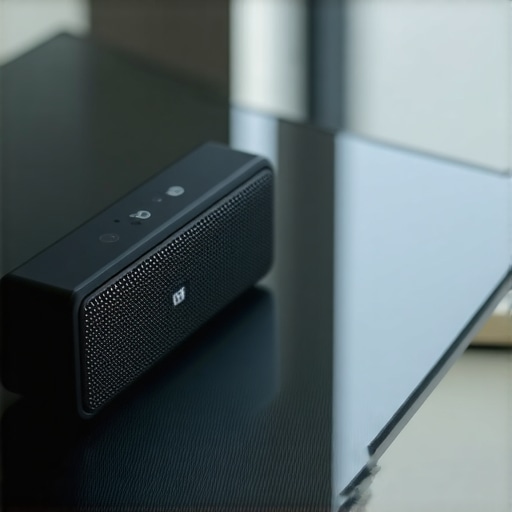
DIY Fixes That Cost Zero Dollars
You don’t need fancy isolation pads or expensive audiophile spikes to fix this. Look for high-density materials you already have around the house. A thick rubber mousepad is an acoustic goldmine. At a recent outdoor BBQ, I used a folded-up neoprene beer koozie as a makeshift stand on a metal table. It acted as a shock absorber, preventing the metal from ringing like a bell. This is one of those 3 budget upgrades that make cheap speakers sound expensive because it focuses on the environment rather than the hardware. If you’re stuck with a glass surface and can’t move the speaker, even a few silicone coasters or a thick magazine can break that connection. This is a similar principle to the best way to position your subwoofer for clearer lows; you are managing how the sound waves interact with the physical boundaries of the room.
Why Heavy Wood Always Wins Over Glass
Density is your best friend when it comes to audio. Wood, especially solid oak or thick MDF, is much more ‘inert’ than glass or thin plastic. It has internal damping properties that naturally soak up those stray vibrations instead of reflecting them back at the speaker. If you find your bluetooth speaker sounds muffled when placed on the floor, it’s usually because the carpet is absorbing the high frequencies too much, but on glass, you have the opposite problem: too much reflection. Glass causes high-frequency splashes that mess with your ears’ ability to track the rhythm and timbre of a voice. This is a primary reason for how to fix the annoying echo in your minimalist home theater—you have to get rid of the hard, flat surfaces that bounce sound like a billiard ball. Moving your speaker to a heavy wooden bookshelf provides the structural support the passive radiators need to actually push against the air, rather than the furniture.
Physics Doesn’t Care How Much You Spent
Most people believe that dropping a thousand dollars on a speaker will automatically fix their audio problems. In my experience, even the most expensive setup can sound like garbage if you don’t respect the room’s acoustics. This is a common industry myth: that gear quality is the only variable. In reality, your room is the most influential component in your signal chain. If you have hard, reflective walls, your bookshelf speakers need more power than you think just to overcome the phase cancellation caused by those reflections. According to a landmark study by the Audio Engineering Society (AES), the ‘Circle of Confusion’—the disconnect between how music is recorded and how it is played back—is often exacerbated by the listener’s environment, not their hardware. You might be buying high-fidelity equipment, but you’re listening to the sound of your walls bouncing that energy back at you. 
Don’t Fry Your Gear by Chasing Volume
The biggest ‘oops’ factor I see with advancing enthusiasts is the assumption that more volume equals more impact. People often crank their systems to 100%, thinking the internal DSP will protect the drivers. However, you should learn how to tell if your amplifier has enough headroom for your speakers before you hit those limits. If you push an amp into clipping, you’re sending a square wave to your speakers, which generates excessive heat and can melt a voice coil in minutes. I’ve seen countless high-end drivers ruined because the owner thought the ‘red light’ on the back was just a suggestion. It’s a trap to think that expensive gear is invincible; it’s actually often more sensitive to user error than cheap, rugged consumer electronics.
Why do my expensive headphones sound thin on a basic smartphone?
It’s a frustrating moment when you unbox a pair of $500 studio cans, plug them into your phone, and they sound quieter and thinner than the earbuds that came in the box. This is a classic nuance involving impedance and sensitivity. You’ll find why your expensive headphones sound thin on a basic smartphone comes down to the output stage of your device—it simply doesn’t have the voltage to move those high-impedance drivers properly. While many ‘audiophile’ brands claim you need specialized cables, is gold plated hardware really worth the extra cash? Usually, no. The real bottleneck is almost always power delivery and signal-to-noise ratios, not the plating on your connectors. Have you ever fallen into this trap of buying better gear only to have it sound worse because of a simple mismatch? Let me know in the comments.
Your Ears Can Tell When Your Gear Is Dirty
It’s easy to focus on the flashy part of the hobby—the unboxing and the first listen—but the real work begins six months later. I’ve visited too many houses where a gorgeous $2,000 stereo system was performing at half its potential simply because the owner didn’t know how to clean dust out of your headphone jack without damaging pins or connectors. Grime and oxidation are the silent killers of fidelity. They introduce micro-resistance that leads to that annoying static or channel imbalance. I once spent an entire Saturday morning thinking my left driver was failing, only to realize that a single strand of Golden Retriever fur had worked its way through the mesh. If you’re a pet owner, learning the trick to removing dog hair from speaker grilles safely will save you more frustration than any software update ever could. According to technical documentation from Sennheiser regarding transducer longevity, environmental factors like humidity and skin oils can prematurely stiffen a driver’s diaphragm, drastically altering the frequency response over time. This isn’t just about aesthetics; it’s about preserving the physical materials that create the vibrations you hear.
How do I keep my home audio system in top shape?
Maintenance isn’t just about cleaning; it’s about monitoring. I keep a close eye on thermal management because heat is the enemy of capacitors. If you ever feel that your amplifier gets hot enough to burn your hand, you are literally cooking the lifespan out of your equipment. Ensure there is at least three inches of breathing room above any heat sink. Additionally, I always recommend a high-quality power conditioner. I learned this the hard way after a summer storm left me googling how to fix a receiver that wont turn on after a power surge. A dedicated protection unit doesn’t just stop surges; it filters out the high-frequency ‘noise’ from your home’s electrical grid that can make your speakers hiss.
Why You Should Own a Multimeter and a 9V Battery
If you want to move from an amateur listener to someone who actually understands their signal chain, you need a few basic tools. The most underrated ‘tool’ in my kit is actually a simple battery. I use how to use a 9v battery to check your speaker polarity whenever I’m setting up a new room. If your speakers are ‘out of phase’—meaning one is pushing while the other is pulling—your bass will vanish, no matter how much you spent on the cabinets. It’s a five-second test that provides absolute certainty. #IMAGE_PLACE_HOLDER_D# I also keep a cheap digital multimeter handy to check for continuity in my cables. You’d be surprised how often a ‘broken’ speaker is actually just a $10 cable with a loose internal solder joint. Looking ahead, I predict we will see more AI-integrated calibration tools built into our phones that can ‘listen’ to our setups and suggest these physical fixes in real-time. But for now, the manual hand-test and a basic toolkit are your best defense against bad sound. My big challenge for you this week: go check your speaker polarity with a battery and make sure you aren’t fighting against your own wiring.
The Hardest Lessons My Glass Coffee Table Ever Taught Me
Looking back at that night with the glass table, I realize my biggest mistake wasn’t the equipment I bought, but my lack of respect for physics. I’ve since learned that the most expensive cable in the world won’t fix a surface that rattles like a bag of marbles. In fact, the truth about gold-plated audio connectors for home stereos is that they are often just a distraction compared to the physical foundation of your room. I also discovered that unwanted resonance is the ultimate clarity killer. It follows the same principle as why your car door vibration is ruining your mid-bass performance; if the surface is absorbing energy, your music is losing its soul. Finally, I’ve learned that volume is never a substitute for clarity. If it sounds thin, adding power just adds noise.
My Essential Toolkit for Better Audio
You don’t need a lab full of measuring equipment to get professional results in your own home. I keep my kit simple and focused on the variables that actually change what I hear. First, a basic digital multimeter is a lifesaver for finding hidden faults in cables. Second, I always keep a 9V battery nearby; how to use a 9v battery to check your speaker polarity is the quickest way to ensure your setup isn’t accidentally working against itself. For those of you wanting to upgrade your gear without the high-end price tag, I’m a huge advocate for finding legitimate high-end gear at local thrift stores. You would be shocked at what people give away simply because they didn’t know how to clean it. #IMAGE_PLACEHOLDER_E#
Go Ahead and Move Your Speaker Today
The best thing you can do for your music right now is to stop reading and start experimenting. Your ears are the most sophisticated audio tools you own, and no guide can replace the feeling of a ‘sweet spot’ clicking into place. When you finally master your environment, you naturally learn how to stop your portable bluetooth speaker from distorting by giving it the stable ground it needs to perform. Music is meant to be an experience, not just background noise. Take control of your setup and let the music speak for itself. Have you ever noticed your portable speaker sounding better just by moving it to a different piece of furniture? Let me know your favorite ‘sweet spot’ in the comments.