
I was sitting there, popcorn in hand, ready for the big finale of an epic sci-fi flick when it happened. The hero screamed, but his mouth didn’t move for another half-second. It was like watching a ventriloquist act where the puppet was a 65-inch OLED. It is maddening, isn’t it? That tiny, jarring gap between a lip moving and the sound hitting your ears can turn a cinematic masterpiece into a frustrating headache. I remember frantically swapping cables and even wondering if my portable speaker losing its charge was somehow a sign of a cursed home theater setup. But the truth was simpler: my HDMI settings were just out of sync. I felt like a failure as a ‘tech guy’ when I realized I’d spent two hours troubleshooting the wrong hardware. We are going to fix that for you right now so you can stop staring at chins and start enjoying the movie.
Fix That Annoying Lag Without Buying New Gear
I spent a lot of money early on thinking that high-end cables were the magic bullet for audio issues. I even fell for the trap of thinking I needed a whole new system because I couldn’t get clear movie dialogue without a dedicated center speaker while dealing with the lag. I was wrong. Most of the time, the delay is caused by the heavy processing your TV does to make 4K images look pretty, which leaves the audio trailing behind. This is a classic case of why your soundbar is delaying the audio behind the actors lips. Today, I am going to show you how to dive into your HDMI-CEC and ARC settings to force those two devices to actually talk to each other in real-time. Have you ever felt like your TV was gaslighting you into thinking the actors were just bad at dubbing? Let me know if you have been stuck in that same loop of resetting your router for no reason.
Is this just something I have to live with forever?
A lot of folks worry that their hardware is simply incompatible or broken, especially if they have run into issues like how to fix a soundbar that has sound but no picture on arc. The good news is that you don’t have to live with it. According to the Audio Engineering Society, listeners can notice lip-sync errors once the audio lags behind the video by more than 45 milliseconds. That is a tiny window! My biggest mistake was adjusting the ‘Audio Delay’ on my soundbar without realizing my TV also had a ‘Game Mode’ that was bypassing the very processing I was trying to compensate for. We are going to look at why HDMI 2.1 and eARC are your best friends in this fight, and how one simple toggle in your expert settings menu can solve the problem for good.
Force Your TV and Soundbar to Talk in Real-Time
First, go into your TV’s system menu and look for anything labeled HDMI-CEC. Brands love to rename this feature—Samsung calls it Anynet+, Sony calls it BRAVIA Sync, and LG calls it SimpLink. This protocol is supposed to let your devices share data, but it often gets tripped up, leading to situations where your soundbar keeps switching inputs by itself. Make sure CEC is toggled ON. If you are using a newer TV, ensure eARC (Enhanced Audio Return Channel) is enabled rather than just standard ARC. eARC has significantly more bandwidth and specifically includes a mandatory lip-sync correction feature that handles the complex math for you.
Kill the Processing Lag That Steals Your Sync
The biggest secret I learned the hard way—while helping my brother-in-law fix a setup that sounded like a badly dubbed 70s kung fu movie—is that “pretty” pictures take time to build. If your TV is busy performing “Ultra Motion Smoothing” or “Noise Reduction,” it holds the video frames back while the audio flies out to the speakers instantly. I once spent three hours trying to fix a wireless subwoofer that keeps losing its pairing, thinking the physical connection was the issue, when the real problem was just the TV’s internal brain being too slow. Switch your TV to “Game Mode” or “PC Mode.” This strips away the heavy processing and forces the video to keep up with the audio. If you are worried that your audio isn’t powerful enough once it is in sync, you should check how to tell if your amplifier has enough headroom for your speakers to ensure you aren’t just hearing digital compression artifacts.
The Secret Dial Hiding in Your Expert Settings
If the auto-sync fails, you have to go manual. Most modern receivers and soundbars have an “Audio Delay” or “A/V Sync” setting. You might hear your expensive receiver making a clicking sound when it starts as it engages these digital processors. Start by setting the delay to zero and then increase it in 10ms increments. I usually pull up a YouTube video of a “Sync Test” (the one with the bouncing ball and the beep) to get it perfect. If you still hear a weird reverb after syncing, you might actually be dealing with room acoustics rather than electronic lag, so look into how to fix the annoying echo in your minimalist home theater. Remember, our brains are better at processing audio that is slightly late than audio that is slightly early, so if you cannot get it 100% perfect, aim for a tiny bit of audio lag rather than video lag.Most “audiophiles” will tell you that if your sound is off-sync or lacks “soul,” you need to drop another $500 on a standalone DAC. Here’s a hot take: why your high-end DAC sounds exactly like your laptop’s headphone jack often comes down to the fact that the bottleneck isn’t the digital conversion—it’s the power delivery and the physical environment. We spend thousands on software-side fixes while ignoring the laws of physics. Let’s dig deeper into why throwing money at “magic boxes” rarely fixes the core issues.
Stop Blaming Your DAC for Physical Power Failures
I have seen it a thousand times: someone buys a $2,000 receiver and then plugs it into a generic $5 power strip they found in the garage. This is the ultimate “oops” factor. I’ve personally witnessed setups where you should avoid using an extension cord for your power amp because it chokes the instantaneous current delivery. This “voltage sag” doesn’t just make the bass sound muddy; it can actually interfere with the internal clock of your processor. When that clock stutters, your perfectly calibrated lip-sync drifts back out of alignment within twenty minutes. 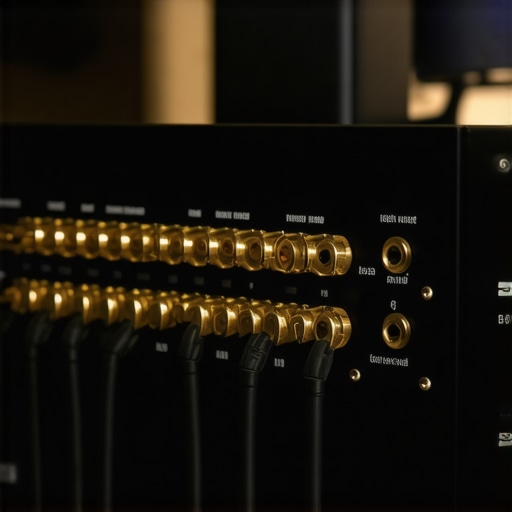
The High-Voltage Trap Most Enthusiasts Ignore
It is a common myth that “power” is only about how loud you can turn the volume knob. In reality, power is about control. This is exactly why your bookshelf speakers need more power than you think—not to wake the neighbors, but to provide enough electrical “grip” to stop the driver from vibrating once the signal stops. If your amp is struggling, your audio will always feel slightly disconnected from the “snap” of the video. If you are running long lines to your gear, remember that choosing the right gauge of wire for long outdoor speaker runs or even long indoor ones is vital for maintaining that damping factor. Low-gauge wire acts like a bottleneck for your amp’s authority over the speaker cone.
Why does my audio sync start perfect but drift over time?
This is the “pro-level” nightmare that drives people crazy. You fix the delay at the start of a movie, but by the final battle, the dialogue is off again. This is usually caused by “clock drift.” According to technical studies by the European Broadcasting Union (EBU), even a fractional difference in the internal timing oscillators between your source device and your soundbar can lead to a cumulative delay that grows over the course of a two-hour film. It is not a “bug” in your settings; it is a hardware heartbeat mismatch that often requires a hard restart of the handshake between devices. Have you ever fallen into this trap of buying “magic” gear only to find out it was a simple power bottleneck causing the headache? Let me know in the comments.
Stop Letting Dust and Heat Kill Your High-End Sound
I’ve realized over the years that the difference between a system that lasts thirty years and one that dies in five isn’t just the price tag; it’s the maintenance. I used to ignore the slight static when turning my volume knob until it became a deafening crackle that almost blew my tweeters. That was a wake-up call. Now, I keep a can of DeoxIT D5 on my workbench at all times. If you are experiencing that same grit, you need to know exactly how to fix a scratchy volume dial with electrical contact cleaner. It’s a ten-minute job that saves you a $200 repair bill. Beyond the dials, those copper connections on the back of your speakers are slowly dying. Oxygen is the enemy here. I make it a habit every six months to check for that dulling shine. Learning how to clean green oxidization off your copper speaker terminals is the simplest way to ensure your signal path remains pure. Heat is another silent killer. If you notice why your vintage amp gets hot even when you arent playing music, it’s often a sign of failing capacitors or biased transistors that need a professional touch before they turn into a fire hazard.
How do I keep my audio system from degrading over time?
Consistency is more important than deep cleans once a year. I treat my gear like a car. For headphones, the biggest issue is skin oils and humidity. If you don’t wipe down your leather or protein-leather cups, you’ll eventually wonder why your headphone pads are flaking and how to prevent it. For portable gear, it’s all about battery cycles. I stopped leaving my Bluetooth speakers plugged in 24/7 because I saw why your portable speaker is losing its charge faster than usual is almost always due to heat-induced chemical aging in the lithium-ion cells. The industry is moving toward a more sustainable ‘repair-first’ mindset, but the best repair is the one you never have to do because you kept the dust out of the vents.
The Pro Tool Hiding in Your Pocket
You don’t need a $1,000 calibrated microphone to start tuning like a pro. While the Dolby Atmos Home Entertainment Installation Guidelines suggest specific spatial coordinates for every speaker, your room’s unique furniture and rugs will always throw those calculations off. I personally use my smartphone as a makeshift RTA (Real Time Analyzer). If you haven’t tried it yet, learning how to use your phone to measure your rooms frequency response will show you exactly where your bass is ‘booming’ and where your dialogue is getting swallowed by reflections. I predict that in the next few years, we will see AI-driven apps that use your phone’s camera and mic to map your room in 3D and automatically push EQ corrections to your soundbar via Bluetooth. We are already halfway there with systems like Sonos Trueplay, but the open-source tools available now give you much more granular control. Don’t just trust your ears; trust the data. I challenge you to download a free SPL meter app today and check if your left and right speakers are actually hitting the same decibel level at your favorite seat—you’ll be shocked at how often they are off by 2 or 3 dB.
What I Learned the Hard Way About Audio Obsession
After years of swapping out cables and buying expensive hardware, the biggest lesson I have learned is that the most expensive fix is rarely the best one. I used to think a new processor was the answer to every lag issue, but I eventually realized that finding the sweet spot for your speakers in a rectangular room did more for my clarity and perceived timing than any $2,000 upgrade ever could. Audio is physical. We get so caught up in digital settings that we forget things like mechanical resonance. For instance, I was shocked to find out why your speaker stands need to be filled with sand—it stops micro-vibrations that smear the ‘attack’ of a sound, making it feel out of sync even when the digital timing is perfect. Don’t let the spec sheets distract you from the laws of physics in your own living room. Another ‘lightbulb moment’ for me was realizing that my ears were being tricked by my eyes; if you are sitting too far from a large screen, the speed of light vs. the speed of sound creates a natural lag that no HDMI setting can fix. Sometimes, you just need to move your chair.
Tools That Saved My Sanity and My Wallet
I don’t go into any setup without a few specific items that have proven their worth over a decade of troubleshooting. First, a simple smartphone RTA app is non-negotiable. It allows you to see the invisible ‘hills and valleys’ of sound in your room. Second, I always keep a bottle of specialized cleaner nearby because learning how to fix a scratchy volume dial with electrical contact cleaner has saved me from replacing three different vintage receivers that I thought were dying. I also highly recommend every enthusiast understands the difference between peak and RMS power explained simply. It’s the best way to prevent yourself from overdriving your equipment and causing the very distortion that makes dialogue sound muddy. Finally, trust your gut—if a ‘magic’ cable costs more than your speakers, it is probably a marketing trick. Stick to the basics of power, placement, and clean connections.
Your Setup is Finally Ready for the Big Screen
It is time to stop staring at the settings menu and start enjoying the art. You have done the hard work of syncing the HDMI handshakes, clearing the processing lag, and ensuring your power delivery is stable. Whether you are aiming for clear movie dialogue without a dedicated center speaker or you are building a full Atmos theater, the goal is immersion. When the tech disappears and you forget you are even looking at a screen, that is when you know you have won. Go put on your favorite film, turn down the lights, and enjoy the perfect harmony of sight and sound. Have you ever managed to fix a persistent audio lag only to realize it was a single hidden setting in your TV? Let me know your ‘Aha!’ moment in the comments below.