
I’ll never forget the first time I tried to host a backyard BBQ with my brand-new, high-end portable speaker. Inside my kitchen, that little box was a absolute beast, thumping with enough low-end to make the spice rack rattle. But the second I stepped onto the grass? It sounded like a mosquito in a windstorm. I actually felt embarrassed. I had spent nearly three hundred dollars on a device that now sounded like a tinny radio from the 1950s. If you’ve ever felt that specific sting of disappointment when your music just… disappears into the open air, you aren’t alone. Today, I’m going to show you exactly why your gear isn’t actually broken and how we can trick physics into giving us that punchy, rich sound back. [image_placeholder]
The Great Outdoors is a Bass-Hungry Void
The biggest mistake I made early on was thinking I just needed more volume. I cranked that dial until the speaker sounded distorted at high volume, but the bass never returned. Here is the cold, hard truth: sound needs surfaces to thrive. Indoors, your walls reflect energy back to your ears. This is known as boundary gain. When you lose those walls, you lose the reinforcement. As noted by the experts at the Audio Engineering Society (AES), the lack of acoustic reflections in an open-air environment means the ‘room gain’—which can boost low frequencies by up to 6dB or more—is completely absent. When those waves have nothing to hit, they just keep traveling until they die out. It’s frustrating. It’s annoying. But it is also fixable if you know where to put your gear.
Will a bigger speaker actually solve the problem?
It’s a fair question. You might be tempted to just throw more money at the problem, assuming a larger driver is the only answer. But even a premium unit will struggle if you don’t understand the environment. I’ve seen people put their gear on a patio table and wonder why it has no bass on a glass surface. I once spent an entire afternoon moving my setup around until I realized that placing it near a wall or a solid corner was the only way to get that ‘oomph’ back. If you just set it in the middle of a field, you’re fighting an uphill battle against the laws of nature. Have you ever set up your speaker for a party only to realize it sounded way worse than it did in the store? I’d love to hear your ‘sound fail’ stories in the comments below. We’re going to dive into how to overcome this, including why placing it on the floor might be muffling your highs while doing nothing to help your low-end response.
Turn Your House Into a Giant Backboard
The most effective way to reclaim that missing low-end is to treat your speaker like a flashlight rather than a lightbulb. Indoors, sound is omnidirectional, but once you go outside, you need to point that energy with intent. Think of it like shouting into a megaphone versus shouting into a pillow. To do this, you need to find a ‘backboard’—usually the exterior wall of your home. By placing the speaker right up against a solid siding or brick wall, you force the sound waves that would normally escape behind the unit to bounce forward toward the party. It’s an immediate 3dB boost for free. I remember a specific July 4th bash where my small JBL felt like it was dying. I moved it from the middle of the yard to the base of the chimney, and suddenly, the kick drum had a physical impact again. It’s exactly why your portable speaker sounds better when placed in a corner; you are essentially using your house to extend the speaker’s cabinet.
Corner Loading is Your Secret Weapon
If one wall is good, two walls are a miracle. If you have an L-shaped nook on your patio or a spot where the deck meets the house, put the speaker there. This creates a ‘horn’ effect. The sound pressure builds up in that tight space and projects outward with much more authority. This is the same principle that explains why your bookshelf speakers need more power than you think when they aren’t getting that environmental help. You aren’t just increasing volume; you’re increasing efficiency. 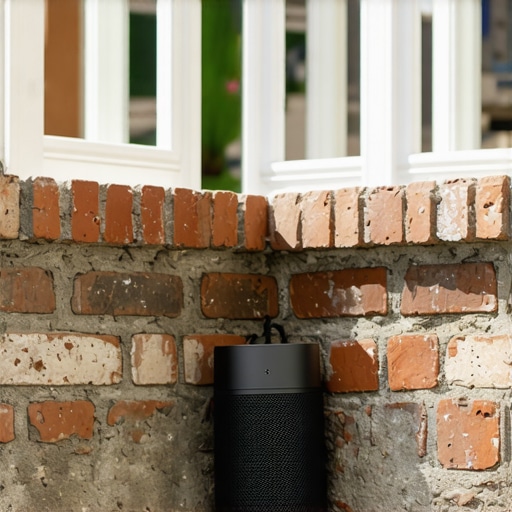
Stop Setting Your Gear on Grass or Glass
We need to talk about what your speaker is actually sitting on. Grass is an acoustic sponge—it literally eats high-frequency detail and does nothing to reflect bass. On the flip side, I’ve mentioned before why your portable speaker has no bass when you place it on glass. Glass vibrates too much, absorbing energy that should be going into the air. Ideally, you want a heavy, dense surface like a concrete step or a thick wooden bench. A dense surface provides a stable platform for the driver to push against. If the surface vibrates, it’s stealing your punch.
Check for Small Air Leaks Before You Give Up
Sometimes the lack of punch isn’t about the yard at all; it’s about the speaker itself failing under the pressure of higher outdoor volumes. If you hear a weird chuffing sound, use the simple paper test for finding air leaks in your speaker cabinet. An air leak in a portable unit is like a flat tire; no matter how much ‘gas’ you give it, it won’t perform. Outdoors, these leaks become glaringly obvious because there’s no room gain to mask them.
Why More Volume Isn’t Always the Answer
The temptation is always to just keep hitting the ‘plus’ button, but you might be hitting a digital ceiling. If you are using a battery-powered unit, the truth about using a fast charger for your portable speaker is that it won’t necessarily give you more juice during playback, but a low battery will definitely throttle your amp’s output. You need to understand the difference between peak and RMS power explained simply to realize that your speaker can only sustain that ‘punch’ for short bursts before the internal limiter kicks in to prevent heat damage. To truly command a large outdoor space, you have to ensure how to tell if your amplifier has enough headroom for your speakers so you aren’t constantly clipping the signal just to hear the lyrics over the wind.
We’ve talked about where to put your speakers, but let’s talk about the energy driving them. If you think a 1000-watt sticker on a box means you’re getting 1000 watts of clean music, you’re falling for the industry’s biggest marketing lie. Most people assume that ‘loud’ is the goal, but in the audiophile world, the goal is control. When you’re outdoors, you’re often pushing your equipment to its absolute limit, and that is where the ‘Oops’ factor kicks in. You start hearing clipping and distortion not because the speaker is bad, but because you don’t understand the difference between peak and RMS power explained simply. Your amp might hit that peak for a millisecond, but it’s the sustained RMS power that keeps the kick drum from sounding like a wet cardboard box.
Stop buying watts and start buying headroom
Here is my contrarian take: stop looking at the wattage number entirely. Instead, look at the power supply and the signal-to-noise ratio. In my experience, a high-quality 50-watt amplifier with a massive transformer will outperform a ‘cheap’ 200-watt digital amp every single day of the week, especially in open-air environments. You need to know how to tell if your amplifier has enough headroom for your speakers so that when the music hits a crescendo, the amp doesn’t choke. Dr. Floyd Toole, a legend in the field of psychoacoustics and former AES president, has long argued that linear power delivery is far more critical to our perception of quality than sheer volume levels. If your amp is struggling, your outdoor party will sound fatiguing rather than fun. Have you ever fallen into the trap of buying gear based solely on the biggest number on the box? Let me know in the comments.
Why do my high-end headphones sound so hollow on a phone?
This is a classic example of the ‘hidden nuance’ in audio. You might spend a fortune on premium gear only to find that your expensive headphones sound thin on a basic smartphone. It’s not a defect; it’s an impedance mismatch. It’s the exact same logic behind why your bookshelf speakers need more power than you think. Without enough voltage to move the drivers properly, you lose the low-end and the soundstage collapses. If you are serious about your sound, you have to match the source to the output, or you’re just throwing money away.
Long wire runs are killing your outdoor bass
If you’re setting up a permanent outdoor system, here is the trap you must avoid: the ‘cheap wire’ shortcut. I’ve seen beautiful patios ruined because the owner used standard indoor wire for a 100-foot run. The truth is that cheap speaker wire causes signal loss over 50 feet, and that loss hits your bass frequencies first. To keep your system punching through the wind, you must learn how to choose the right gauge of wire for long outdoor speaker runs. If you use wire that is too thin, you are essentially putting a kink in the garden hose of your audio signal. 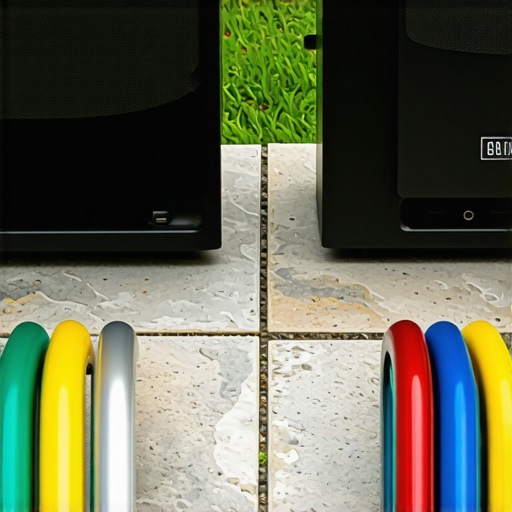
Audio gear isn’t just a purchase; it’s an investment that the environment is constantly trying to liquidate. If you leave your equipment outside—or even if it just lives in a humid basement—entropy is your biggest enemy. I’ve seen thousand-dollar systems reduced to paperweights because of a single loose connection or a bit of moisture. The first tool I always recommend keeping in your ‘audio survival kit’ is a can of DeoxIT D5. This isn’t just WD-40 for electronics; it’s a specific chemical deoxidizer. When you learn how to fix a scratchy volume dial with electrical contact cleaner, you aren’t just cleaning a part; you are restoring the signal path. This is especially vital for outdoor terminals. Over time, moisture creates a nasty crust that kills conductivity. You need to know how to clean green oxidization off your copper speaker terminals before it eats through the wire entirely.
How do I keep my outdoor audio gear sounding like new for years?
Maintenance is mostly about prevention and periodic ‘health checks.’ Once a season, I pull all my connections apart and re-seat them. I also check the physical integrity of the speakers. UV rays are the silent killer of outdoor audio. They turn soft rubber surrounds into brittle crackers and bleach your aesthetics. Luckily, it is surprisingly easy to restore a sun-faded speaker grille to look new again with a bit of specialized trim paint. Beyond the surface, keep an eye on the electronics. According to detailed component lifespan studies from the IEEE, electrolytic capacitors are the most likely point of failure in aging amplifiers, often losing effective capacitance as the internal electrolyte dries out over time. You should learn how to tell if your speakers capacitor is starting to fail by listening for a gradual loss of bass or an increase in background hum. 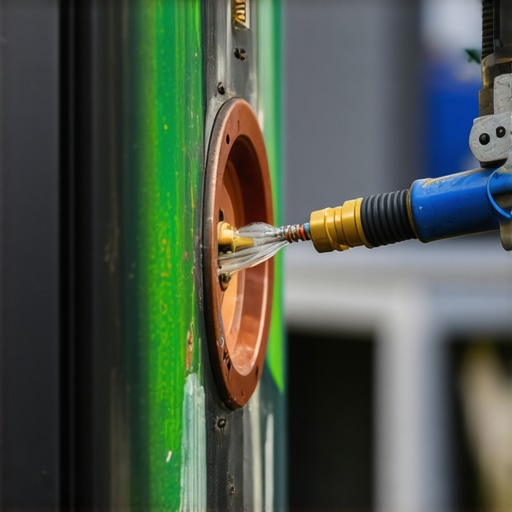
Why your stands need a literal weight on their shoulders
If you’ve moved past portable Bluetooth boxes and into serious outdoor speakers on stands, you’ve probably noticed they can feel a bit ‘flighty’ when the wind picks up or the volume gets high. This is where a lot of people go wrong. They buy heavy speakers but put them on hollow metal tubes. The reason your speaker stands need to be filled with sand isn’t just about weight for safety; it’s about acoustic mass. Sand-filling stops the stand itself from ringing like a bell, which can muddy your sound and ruin your stereo imaging. It is one of those ‘pro-level’ tweaks that costs almost nothing but makes your system sound twice as expensive.
The future of backyard sound belongs to AI
Looking ahead, I predict we are entering the era of ‘Adaptive Outdoor DSP.’ Currently, we have to manually trick physics by placing speakers in corners. However, I believe within five years, high-end outdoor amps will use AI-driven microphones to ‘map’ the yard in real-time. These systems will detect things like wind speed and ambient noise, instantly recalibrating the EQ to ensure you never lose that punchy low-end, regardless of where the speaker is sitting. For now, we still have to do the legwork ourselves. I want you to try this one specific tip: tonight, go out and fill your hollow speaker stands with dry kiln-sand. The difference in mid-bass clarity is something you have to hear to believe. You aren’t just improving the sound; you’re anchoring your investment against the elements.
The Brutal Truths My Backyard Parties Taught Me
After years of hosting, I’ve realized that the spec sheet on the box is often just a fairy tale. Real-world performance is about environmental control. First, I learned that a rattling enclosure can ruin even the most expensive experience; thankfully, there is the easiest way to fix a rattling speaker grill for good by using simple dampening techniques. Second, never ignore small physical damage. I once ignored a tiny tear, but learning how to fix a small rip in a speaker surround with glue saved me from buying a whole new unit. Finally, remember that your power source matters more than you think. If you notice why your portable speaker is losing its charge faster than usual, your bass response will be the first thing to suffer as the internal amplifier struggles to maintain voltage peaks.
My Field-Tested Toolkit for Every Audio Setup
I don’t leave my sound to chance anymore. Here are the things I always keep in my ‘sound bag’ for every event. First, a high-quality chemical deoxidizer for terminals prevents that dreaded green crust that kills your signal. Second, I keep a restoration kit for older gear, because the trick to making vintage speakers sound modern again often just involves refreshing the physical signal path and tightening the connections. Third, I always carry a dedicated high-capacity power bank to ensure the amp stays consistent. Fourth, I have a ‘reference’ playlist I know by heart; if the low-end doesn’t feel right on those specific tracks, I know I need to move the speaker closer to a wall.
Let the Music Take Over Your Next Party
Sound isn’t just about decibels; it’s about creating a mood that lasts long after the sun goes down. By understanding how to fight back against the open air, you ensure your portable speaker performs at its absolute peak rather than sounding like a tinny afterthought. Don’t be afraid to move things around, experiment with different surfaces, and keep your connections clean from the elements. Your ears—and your guests—will thank you for the extra effort. What is the one thing you always forget to check before the music starts? Let me know in the comments below!