
I sat there on my living room floor, staring at my speakers with a mix of frustration and genuine confusion. I had just finished trying the trick to making cheap bookshelf speakers sound expensive, but instead of rich, room-filling audio, I got… well, nothingness. The vocals felt like they were coming from behind me, and the bass had completely vanished. I felt like a total amateur. I checked the volume, I checked the source, and I even considered if I needed to use a multimeter to find a short in your speaker wires. It turns out, I’d made the most classic rookie mistake in the book: I had wired one speaker backwards. My speakers were out of phase, and they were literally fighting each other for control of the air in the room. If your music feels hollow, thin, or just plain ‘wrong,’ you’re probably suffering from the same easy-to-fix headache. Today, I’m going to walk you through the simplest ways to identify this problem so you can finally hear your music the way it was meant to be heard.
Stop Guessing and Start Listening for the Phantom Center
Phase is just a fancy way of saying that your speakers are moving in sync. When they are ‘in phase,’ the cones move forward and backward at the same time. When they are out of phase, one pushes while the other pulls. This creates destructive interference, which effectively cancels out the low-end frequencies. Have you ever felt like the singer in a song was suddenly invisible or ‘drifted’ to the far edges of the room instead of standing right in front of you? That is the hallmark of a phase issue. Even if you have already mastered how to match your subwoofer phase with your main speakers, if your left and right channels aren’t aligned, the whole soundstage collapses. According to the experts at Audioholics, destructive interference caused by reversed polarity is the number one reason DIY home theaters sound ‘thin’ regardless of how much the equipment cost.
Does Phase Really Matter as Much as People Say?
You might be thinking, ‘If I can still hear the music, isn’t it fine?’ I thought that too, until I realized I was losing about 60% of my speakers’ potential. When your speakers are out of phase, your amplifier is working twice as hard to produce half the impact. It isn’t just about ‘audiophile perfection’; it’s about getting the hardware you paid for to actually function. It’s like driving a car with one wheel spinning backward—you’ll move, but it’s going to be a bumpy, inefficient ride. Before you go out and buy new gear, we need to do a few quick ‘neighborly’ tests to see if a simple wire swap is all you need. Have you ever noticed your system sounding better in one specific spot but completely empty just a few feet away?The first thing you need to do is get behind your gear and look at the physical connections. It sounds simple, but labels on wires can be incredibly subtle. One time, I was setting up a vintage system in a dimly lit basement and I didn’t realize the ‘ribbed’ side of the wire was actually the negative. If you’re messing with old equipment, this is the perfect time to learn how to clean gold-plated connectors without ruining the finish. A clean contact ensures that even if you’re in phase, you aren’t losing signal to oxidation. Check that the red terminal on your amp goes to the red on the speaker, and black goes to black. If one speaker is flipped, you’ve found your culprit.
Use the Mono Test to Find the Phantom Center
If the wires look okay but something still feels off, use your ears. Find a mono recording or toggle your receiver to mono mode. In a perfectly phased system, the sound should seem to come from a single point directly between the speakers. This is the ‘phantom center.’ If the sound seems to jump to the walls or feels like it’s pushing against your eardrums with a weird pressure, they are out of phase. This is actually the secret to getting crisp dialogue without a center channel; when things are in phase, the center image is so strong you’d swear a speaker was sitting right there. When the speakers fight each other, that center vanishes and you’re left with a ‘hole’ in the middle of your music.
The Foolproof 9V Battery Hardware Check
When visual inspection and listening leave you guessing, go for the hardware test. Take a standard 9V battery and touch the speaker wires to the terminals briefly. If the speaker cone moves forward, you have the positive wire on the positive battery terminal. If it pulls inward, it’s backward. I used this trick when I was trying to figure out how to fix a loose speaker terminal on your cabinet and couldn’t tell which internal wire was which. Just a quick tap is all it takes—don’t hold it there, or you’ll heat up the voice coil. If both speakers move outward when the battery is applied in the same polarity, you are officially in phase.
I Almost Tore Apart a Vintage Amp Over a Flipped Wire
I remember a specific Saturday afternoon working on an old Marantz. I was convinced the left channel was dying because the sound was so thin and hollow. I spent two hours researching how to fix channel imbalance on a vintage stereo amplifier and was ready to start desoldering capacitors. Right before I opened the chassis, I noticed the speaker wire on the left channel was just slightly frayed and touching the opposite terminal, creating a phase dip. I swapped the leads and secured the connection, and suddenly the room exploded with bass. It wasn’t a broken amp; it was a five-second wiring fix. Always check the phase before you blame the hardware.
The Myth of Red to Red and Black to Black
Most people assume that if they have meticulously matched the colors on their terminals, their system is performing at 100%. In my experience, this is where the real frustration begins. While matching polarity is the first step, I have seen dozens of setups where the owner was technically ‘in phase’ but suffering from massive frequency cancellations. The contrarian truth is that your room acts like a giant, invisible processor that can flip the phase of certain frequencies before they ever reach your ears. According to acoustical expert Dr. Floyd Toole in his research on sound reproduction, room boundaries and reflections can create standing waves that cancel out bass frequencies just as effectively as a reversed wire. This is why you might have perfect connections but still feel that the low-end is missing.
Why Does My System Sound Phased Even When the Wires Are Right?
If you have double-checked your cables and the 9V battery test passed, the culprit is likely destructive interference from your walls. This is particularly common if you are dealing with why your floorstanding speakers sound boomy in the corner; those corners create early reflections that can arrive at your listening position slightly out of sync with the direct sound. I once spent a whole weekend chasing a ‘thin’ sound in a client’s studio only to realize their left speaker was reflecting off a large glass window, creating a phase dip at 150Hz. Before you blame your equipment, try shifting your speakers just six inches in any direction.
The Furniture Trap That Kills Your Bass
Here is the biggest ‘oops’ factor I see: people trying to hide their gear for the sake of aesthetics. I cannot tell you how many times I have been called to ‘fix’ a system where the owner had hidden their sub. You should never place your subwoofer inside a cabinet because the enclosure itself creates its own resonance and phase shifts that no amount of EQ can fix. This is a classic example of the mistake youre making when positioning your subwoofer. When the sub is trapped, its output fights against the cabinet walls, and by the time the sound reaches you, it is completely out of alignment with your main bookshelf speakers.
Solving the Hidden Nuance of Integration
For the more advanced listeners, the real challenge isn’t the left and right speakers—it’s the crossover point between your sub and your mains. Even if your wires are correct, the timing of the sound waves might be off. If your sub is five feet further away than your speakers, the sound waves won’t hit your ears at the same time. This is where learning how to match your subwoofer phase with your main speakers becomes essential. You can often fix this by using the ‘phase’ switch on the back of your sub or by adjusting the distance settings in your receiver. Sometimes, the simplest fix for a harsh, phasey-sounding room isn’t digital at all; I often recommend people use a rug to stop your speakers from sounding harsh and to help absorb those tricky floor reflections. Have you ever fallen into the trap of blaming your wires when it was actually just a bad corner placement? Let me know in the comments below!Once you’ve nailed the phase and placement, you’re 90% of the way there. But the last 10%—the part that separates the weekend warriors from the lifers—is maintenance. I used to think that once a system was set, it was set for good. I was wrong. Over time, air and moisture create a microscopic layer of oxidation on your plugs. I’ve seen people stop wasting money on expensive optical cables only to plug a cheap copper one into a dirty, oxidized port. It’s a bottleneck that kills your transparency. According to technical bulletins from Caig Laboratories, even a tiny amount of surface contamination can increase contact resistance enough to audibly degrade high-frequency detail. This is why I religiously use a high-quality contact cleaner every six months. If you’ve never done it, you need to learn how to clean gold-plated connectors without ruining the finish. It’s the cheapest ‘upgrade’ you’ll ever make for your soundstage. 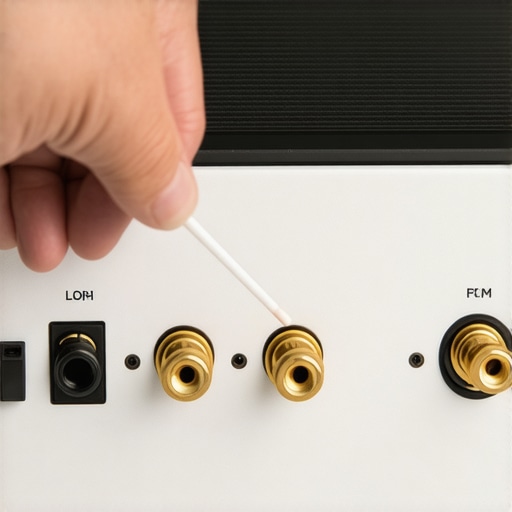
How do I make my audio setup last a lifetime?
The secret isn’t buying more gear; it’s protecting what you have already invested in. I’ve seen too many people try to ‘dust’ their setup and end up destroying a delicate driver. Whatever you do, you should never use compressed air to clean a silk dome tweeter. The pressure can literally deform the material or push dust deeper into the voice coil gap, leading to permanent distortion. Maintenance also extends to your personal audio. If your favorite cans are starting to feel a bit ‘mushy’ or the isolation isn’t as crisp as it used to be, check for the 7 signs your headphone pads need replacing today. Fresh pads restore the intended seal and frequency response that the engineers spent years perfecting. For those of us running vintage amps, keep an eye on the internals; you need to know how to tell if your speaker capacitors are starting to leak before they take out your entire power stage. Looking forward, I predict that physical maintenance will soon be coupled with AI-driven diagnostic tools that ‘listen’ to your speakers’ impedance curve via your phone to alert you when a component is failing. For now, your best tool is a simple bottle of isopropyl alcohol and a watchful eye. Go grab a microfiber cloth right now and give your main amp’s terminals a quick wipe—you’ll be surprised what kind of grime comes off.I sat there on my living room floor, staring at my speakers with a mix of frustration and genuine confusion. I had just finished trying the trick to making cheap bookshelf speakers sound expensive, but instead of rich, room-filling audio, I got… well, nothingness. The vocals felt like they were coming from behind me, and the bass had completely vanished. I felt like a total amateur. I checked the volume, I checked the source, and I even considered if I needed to use a multimeter to find a short in your speaker wires. It turns out, I’d made the most classic rookie mistake in the book: I had wired one speaker backwards. My speakers were out of phase, and they were literally fighting each other for control of the air in the room. If your music feels hollow, thin, or just plain ‘wrong,’ you’re probably suffering from the same easy-to-fix headache. Today, I’m going to walk you through the simplest ways to identify this problem so you can finally hear your music the way it was meant to be heard.
Stop Guessing and Start Listening for the Phantom Center
Phase is just a fancy way of saying that your speakers are moving in sync. When they are ‘in phase,’ the cones move forward and backward at the same time. When they are out of phase, one pushes while the other pulls. This creates destructive interference, which effectively cancels out the low-end frequencies. Have you ever felt like the singer in a song was suddenly invisible or ‘drifted’ to the far edges of the room instead of standing right in front of you? That is the hallmark of a phase issue. Even if you have already mastered how to match your subwoofer phase with your main speakers, if your left and right channels aren’t aligned, the whole soundstage collapses. According to the experts at Audioholics, destructive interference caused by reversed polarity is the number one reason DIY home theaters sound ‘thin’ regardless of how much the equipment cost.
Does Phase Really Matter as Much as People Say?
You might be thinking, ‘If I can still hear the music, isn’t it fine?’ I thought that too, until I realized I was losing about 60% of my speakers’ potential. When your speakers are out of phase, your amplifier is working twice as hard to produce half the impact. It isn’t just about ‘audiophile perfection’; it’s about getting the hardware you paid for to actually function. It’s like driving a car with one wheel spinning backward—you’ll move, but it’s going to be a bumpy, inefficient ride. Before you go out and buy new gear, we need to do a few quick ‘neighborly’ tests to see if a simple wire swap is all you need. Have you ever noticed your system sounding better in one specific spot but completely empty just a few feet away?The first thing you need to do is get behind your gear and look at the physical connections. It sounds simple, but labels on wires can be incredibly subtle. One time, I was setting up a vintage system in a dimly lit basement and I didn’t realize the ‘ribbed’ side of the wire was actually the negative. If you’re messing with old equipment, this is the perfect time to learn how to clean gold-plated connectors without ruining the finish. A clean contact ensures that even if you’re in phase, you aren’t losing signal to oxidation. Check that the red terminal on your amp goes to the red on the speaker, and black goes to black. If one speaker is flipped, you’ve found your culprit.
Use the Mono Test to Find the Phantom Center
If the wires look okay but something still feels off, use your ears. Find a mono recording or toggle your receiver to mono mode. In a perfectly phased system, the sound should seem to come from a single point directly between the speakers. This is the ‘phantom center.’ If the sound seems to jump to the walls or feels like it’s pushing against your eardrums with a weird pressure, they are out of phase. This is actually the secret to getting crisp dialogue without a center channel; when things are in phase, the center image is so strong you’d swear a speaker was sitting right there. When the speakers fight each other, that center vanishes and you’re left with a ‘hole’ in the middle of your music.
The Foolproof 9V Battery Hardware Check
When visual inspection and listening leave you guessing, go for the hardware test. Take a standard 9V battery and touch the speaker wires to the terminals briefly. If the speaker cone moves forward, you have the positive wire on the positive battery terminal. If it pulls inward, it’s backward. I used this trick when I was trying to figure out how to fix a loose speaker terminal on your cabinet and couldn’t tell which internal wire was which. Just a quick tap is all it takes—don’t hold it there, or you’ll heat up the voice coil. If both speakers move outward when the battery is applied in the same polarity, you are officially in phase.
I Almost Tore Apart a Vintage Amp Over a Flipped Wire
I remember a specific Saturday afternoon working on an old Marantz. I was convinced the left channel was dying because the sound was so thin and hollow. I spent two hours researching how to fix channel imbalance on a vintage stereo amplifier and was ready to start desoldering capacitors. Right before I opened the chassis, I noticed the speaker wire on the left channel was just slightly frayed and touching the opposite terminal, creating a phase dip. I swapped the leads and secured the connection, and suddenly the room exploded with bass. It wasn’t a broken amp; it was a five-second wiring fix. Always check the phase before you blame the hardware.
The Myth of Red to Red and Black to Black
Most people assume that if they have meticulously matched the colors on their terminals, their system is performing at 100%. In my experience, this is where the real frustration begins. While matching polarity is the first step, I have seen dozens of setups where the owner was technically ‘in phase’ but suffering from massive frequency cancellations. The contrarian truth is that your room acts like a giant, invisible processor that can flip the phase of certain frequencies before they ever reach your ears. According to acoustical expert Dr. Floyd Toole in his research on sound reproduction, room boundaries and reflections can create standing waves that cancel out bass frequencies just as effectively as a reversed wire. This is why you might have perfect connections but still feel that the low-end is missing.
Why Does My System Sound Phased Even When the Wires Are Right?
If you have double-checked your cables and the 9V battery test passed, the culprit is likely destructive interference from your walls. This is particularly common if you are dealing with why your floorstanding speakers sound boomy in the corner; those corners create early reflections that can arrive at your listening position slightly out of sync with the direct sound. I once spent a whole weekend chasing a ‘thin’ sound in a client’s studio only to realize their left speaker was reflecting off a large glass window, creating a phase dip at 150Hz. Before you blame your equipment, try shifting your speakers just six inches in any direction.
The Furniture Trap That Kills Your Bass
Here is the biggest ‘oops’ factor I see: people trying to hide their gear for the sake of aesthetics. I cannot tell you how many times I have been called to ‘fix’ a system where the owner had hidden their sub. You should never place your subwoofer inside a cabinet because the enclosure itself creates its own resonance and phase shifts that no amount of EQ can fix. This is a classic example of the mistake youre making when positioning your subwoofer. When the sub is trapped, its output fights against the cabinet walls, and by the time the sound reaches you, it is completely out of alignment with your main bookshelf speakers.
Solving the Hidden Nuance of Integration
For the more advanced listeners, the real challenge isn’t the left and right speakers—it’s the crossover point between your sub and your mains. Even if your wires are correct, the timing of the sound waves might be off. If your sub is five feet further away than your speakers, the sound waves won’t hit your ears at the same time. This is where learning how to match your subwoofer phase with your main speakers becomes essential. You can often fix this by using the ‘phase’ switch on the back of your sub or by adjusting the distance settings in your receiver. Sometimes, the simplest fix for a harsh, phasey-sounding room isn’t digital at all; I often recommend people use a rug to stop your speakers from sounding harsh and to help absorb those tricky floor reflections. Have you ever fallen into the trap of blaming your wires when it was actually just a bad corner placement? Let me know in the comments below!Once you’ve nailed the phase and placement, you’re 90% of the way there. But the last 10%—the part that separates the weekend warriors from the lifers—is maintenance. I used to think that once a system was set, it was set for good. I was wrong. Over time, air and moisture create a microscopic layer of oxidation on your plugs. I’ve seen people stop wasting money on expensive optical cables only to plug a cheap copper one into a dirty, oxidized port. It’s a bottleneck that kills your transparency. According to technical bulletins from Caig Laboratories, even a tiny amount of surface contamination can increase contact resistance enough to audibly degrade high-frequency detail. This is why I religiously use a high-quality contact cleaner every six months. If you’ve never done it, you need to learn how to clean gold-plated connectors without ruining the finish. It’s the cheapest ‘upgrade’ you’ll ever make for your soundstage.
How do I make my audio setup last a lifetime?
The secret isn’t buying more gear; it’s protecting what you have already invested in. I’ve seen too many people try to ‘dust’ their setup and end up destroying a delicate driver. Whatever you do, you should never use compressed air to clean a silk dome tweeter. The pressure can literally deform the material or push dust deeper into the voice coil gap, leading to permanent distortion. Maintenance also extends to your personal audio. If your favorite cans are starting to feel a bit ‘mushy’ or the isolation isn’t as crisp as it used to be, check for the 7 signs your headphone pads need replacing today. Fresh pads restore the intended seal and frequency response that the engineers spent years perfecting. For those of us running vintage amps, keep an eye on the internals; you need to know how to tell if your speaker capacitors are starting to leak before they take out your entire power stage. Looking forward, I predict that physical maintenance will soon be coupled with AI-driven diagnostic tools that ‘listen’ to your speakers’ impedance curve via your phone to alert you when a component is failing. For now, your best tool is a simple bottle of isopropyl alcohol and a watchful eye. Go grab a microfiber cloth right now and give your main amp’s terminals a quick wipe—you’ll be surprised what kind of grime comes off.
Hard Truths I Learned While Chasing the Perfect Soundstage
After years of messing with wires, I’ve realized that being “in phase” is more of a spectrum than a simple toggle switch. Here are the core lessons that saved my sanity:
- Your ears are more sensitive than a multimeter for imaging. If the vocals feel like they are stretching toward the walls, trust your gut even if the labels look correct.
- Room acoustics can simulate phase issues. I discovered that why your floorstanding speakers need more breathing room from the wall is often the solution to a thin sound that wires alone can’t fix.
- Be patient with mechanical break-in. I used to troubleshoot phasing for hours on new gear, forgetting why your new speakers sound better after 20 hours of use.
My Essential Toolkit for Better Audio
Before you go out and buy a new amplifier, check these resources and tools that have served as my audio “lifelines” over the years:
For deep theory, I always return to F. Alton Everest’s Master Handbook of Acoustics. It explains the math behind the phase cancellation we discussed today. For hardware, a bottle of DeoxIT is non-negotiable; knowing how to clean gold-plated connectors without ruining the finish is the most underrated skill in the hobby. Finally, remember that high-end sound doesn’t require a high-end budget. We proved this when we showed how we made a 20 thrift store speaker sound like a pro monitor using simple physics and careful placement.
Stop Tweaking and Start Enjoying the Music
Correcting a system that is out of phase is a rite of passage for every music lover. It is the moment you stop being a passive listener and start becoming a curator of your own experience. Once the wires are snug and the center image is locked in, take a breath. You’ve done the hard part. Now, let the equipment fade into the background and let the music take over. Have you ever spent hours troubleshooting only to find a single flipped wire was the culprit? Let me know your most embarrassing “doh!” moment in the comments below!