
Last July, I threw what I thought was going to be the ultimate backyard bash. I’d just picked up a new portable speaker that sounded like a beast in my living room; we’re talking window-rattling low end that made my coffee table migrate across the floor. But the second I stepped onto the patio and hit play, I actually walked back inside to check if I’d accidentally grabbed an old, beat-up transistor radio instead. The bass had vanished. It was just gone, leaving nothing but a thin, screechy ghost of the sound I’d paid good money for. I felt like a total amateur standing there in front of my friends, fiddling with EQ settings that did absolutely nothing while the music sounded like it was coming from the bottom of a tin bucket.
The Disappearing Act of Outdoor Audio
It’s a heart-breaking realization when your gear fails you exactly when you need it most. You aren’t crazy, and your speaker probably isn’t broken—even if it suddenly feels like your bluetooth speaker is quieter than it used to be. The problem is a brutal mix of physics and environment. When you’re inside, those deep bass waves bounce off your walls, floor, and ceiling. This “room gain” reinforces the sound, making it feel powerful and physical. Outdoors? Those waves just travel forever into the empty air, never to return. I made the classic mistake of thinking that if a speaker sounded good in a showroom, it would sound the same in a field. I couldn’t have been more wrong. I spent hours trying to “break it in” thinking the drivers were stiff, much like why your new speakers sound better after 20 hours of use, but the real culprit was the lack of boundaries.
Is my expensive gear actually worth the investment outdoors?
You might be wondering if you just bought a lemon or if these high-end brands are selling us snake oil. I’ve been there, staring at a expensive cylinder of plastic wondering where my money went. The truth is, even the best portable units struggle without physical boundaries to lean on. Think about it: there is a reason you should never buy a soundbar without a dedicated subwoofer for your home—moving air requires mass and enclosure support. In the great outdoors, you’re fighting an uphill battle against infinite space. According to the Acoustical Society of America, sound intensity outdoors follows the Inverse Square Law, where sound pressure levels drop significantly as distance increases, but low frequencies suffer most because they lack the directional focus of high notes. Have you ever felt that sinking feeling when your favorite bass-heavy track suddenly sounds like a phone speaker the moment you step outside? Today, we’re going to fix that. I’m going to show you how to trick physics into giving you that thump back without buying a whole new system.
Why Your Yard is a Bass Killer
The environment is everything when it comes to acoustics. You’ve probably noticed how your bluetooth speaker sounds better on a wooden table compared to a metal one; that’s because the wood acts as a secondary resonator. When you move to the backyard, the grass and open air act like a giant sponge. Unlike your living room, there are no walls to reflect the energy back to your ears. We are going to look at how to use “boundary loading” to reclaim that lost punch.
Stick Your Speaker in a Corner
The most effective way to fight the outdoor bass-drain is a trick called boundary loading. It’s basically physics for lazy people. When you place a speaker in the middle of a yard, the sound waves travel 360 degrees, wasting half their energy moving away from your ears. But if you shove that speaker against a solid wall, those waves hit the surface and bounce back toward the party. You’re essentially turning your house into a giant megaphone. I remember a humid Saturday last August when I finally stopped trying to crank the volume and instead tucked my rugged portable unit right into the corner where my brick siding meets the sliding glass door. The difference wasn’t subtle; it was like someone had suddenly plugged in a hidden sub. The low-end frequencies were forced to travel along the walls rather than dissipating into the ether. This is very similar to the mistake you’re making when positioning your subwoofer indoors—location is often more important than the wattage on the box.
The Ground is Your Secret Weapon
If you don’t have a wall nearby, use the floor. Many people instinctively want to put their speakers at ear level, maybe on a high table or a shelf. While that’s great for high-frequency clarity, it’s a death sentence for your thump. By placing the speaker directly on a hard patio or a stone walkway, you engage in what’s known as ‘half-space loading.’ The ground acts as a reflecting plane that reinforces the bass waves. Much like how to get better bass from a bookshelf speaker without a sub, using the nearest large, flat surface can provide a 3dB to 6dB boost in perceived low-end. 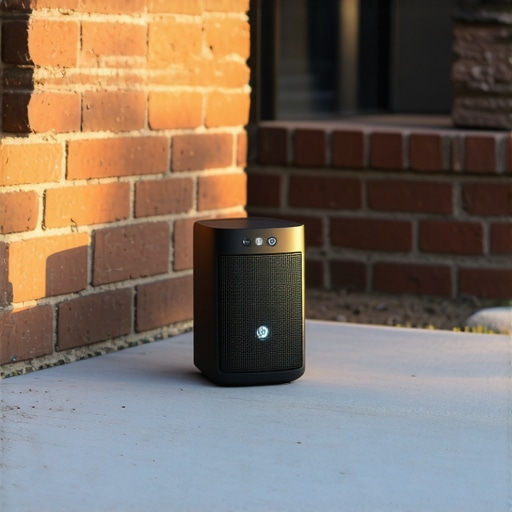
Ditch the Soft Surfaces Immediately
I’ve seen plenty of people set their speakers on a grass lawn or, even worse, on top of a cushioned outdoor chair. Grass is a literal acoustic sponge; it’s designed to absorb energy. If you want that physical kick, you need a dense, reflective surface. I once spent an hour troubleshooting a ‘muddy’ sound only to realize my speaker was sitting on a thick outdoor rug. The moment I moved it to the concrete, the kick drum regained its snap. You’ve likely noticed why your bluetooth speaker sounds better on a wooden table—it’s because the density of the wood allows for better vibration transfer than soft fabric. If you’re on a deck, try to find a spot over a support beam where the wood is most rigid.
Manage Your Power and Expectations
If you’re pushing a small speaker to its absolute limit to compensate for the open air, you’re going to hit a wall of distortion. Think of it like trying to fill a stadium with a megaphone; eventually, the sound just breaks. Sometimes the hardware just needs more juice. While we usually discuss this in the context of high-fidelity listening, knowing how to tell if your headphones need an external amp applies to portable speakers too—if they are underpowered for the environment, they will always sound thin. If your speaker has a ‘Bass Boost’ mode, use it sparingly. It often just compresses the signal, which might make it louder, but will also make it sound like a muddy mess. Instead, focus on the physical boundary tricks first.Most people think that if they just throw more power at the problem, the bass will return. They look for the highest wattage number on the box and assume that’s the fix. But in my experience, brute force wattage is often the most expensive way to get the worst results. You can have a 500-watt monster that still sounds thin because of the ‘Baffle Step Effect.’ This phenomenon occurs when low-frequency waves—which are physically long—wrap around the speaker cabinet rather than being pushed forward. According to research by Dr. Floyd Toole in Sound Reproduction: The Acoustics and Psychoacoustics of Loudspeakers and Rooms, once the wavelength exceeds the width of the speaker face, you lose significant output. This is precisely the real reason your floorstanding speakers sound hollow in large rooms, and outdoors, the effect is magnified to the extreme. 
The Phase Cancellation Trap
Then there’s the common mistake of ‘more is better.’ I see people grab a second speaker to beef up the sound, only to find the bass gets weaker. If you do not position them perfectly, the waves from one speaker can literally collide with and cancel out the waves from the other. This is the easy way to test if your speakers are out of phase, which is a mistake that kills your low-end faster than any open field ever could. Before you go spending money on the real difference between gold and silver plated connectors—which, let’s be honest, won’t help your backyard party one bit—check your wiring and speaker alignment. We often see similar physics at play when people wonder why your car speakers sound better with the windows rolled up; it is all about containing that pressure.
Why does your high-end gear sound hollow in the open air?
It’s because many premium speakers are tuned for ‘critical listening’ in treated indoor rooms. They rely on the pressure gain of a small enclosure. When you take them outside, you’re essentially asking a marathon runner to sprint in deep sand. If you’re trying to expand your setup for a permanent outdoor patio, you might consider how to wire two subwoofers to a single mono amp for a dedicated outdoor low-end zone, rather than overworking your mains. Have you ever fallen into this trap where adding more speakers actually made it sound worse? Let me know in the comments.
It’s not just about where you put the speaker today; it’s about making sure that speaker actually turns on next summer. Outdoor environments are fundamentally hostile to electronics. Between the UV rays eating your speaker surrounds and the fine grit of pollen clogging up your ports, your gear is under constant siege. I’ve seen $1,000 setups sound like garbage within two seasons simply because the owner ignored the basics of gear hygiene.
The Silent Killers of Outdoor Hardware
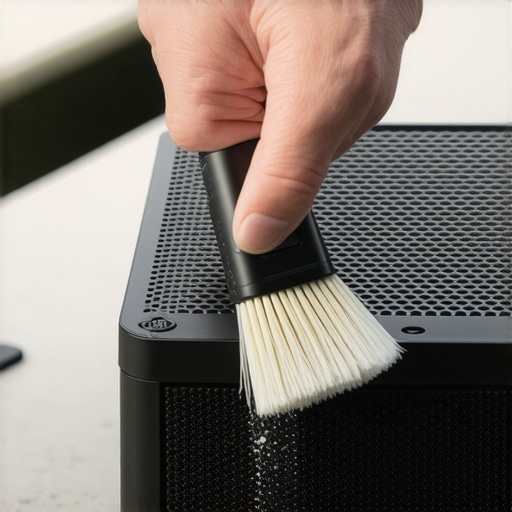
Dust is the most underrated enemy. Inside, it’s a nuisance; outside, it combines with humidity to create a conductive paste that can short out internal components. I personally keep a dedicated 1-inch soft-bristle paintbrush in my audio kit. It is the only tool I trust for cleaning because it lets me get into the grooves of a grill without pushing the dirt deeper into the cabinet. You have to be incredibly careful with the drivers themselves; knowing how to clean your speaker cones without ruining the paper is a skill that separates the pros from the people who end up with soggy, ruined woofers.
Don’t Let a Tiny Crack Ruin a Big Investment
The heat of the sun causes the rubber surrounds—the part that connects the cone to the frame—to expand and contract. Over time, they become brittle and crack. If you catch it early, you can save it. I’ve personally used specialized rubber adhesives to extend the life of my patio monitors by years. Learning how to repair a tear in your speaker surround with rubber glue is much cheaper than buying a replacement driver. According to the IEC 60529 standard for Ingress Protection, even gear rated as IPX7 for water resistance isn’t necessarily proof against long-term solar degradation. I always recommend using a UV-rated protective spray on non-moving plastic parts once a year to prevent that ugly chalky oxidation.
How do I maintain my outdoor audio equipment over time?
Maintenance is a game of consistency. Every three months, I pull my portable units inside for a deep inspection. I check the charging ports first, as these are high-traffic failure points. If you find your plug is feeling wobbly, it’s best to learn how to fix a loose charging port on your favorite bluetooth speaker before it snaps off entirely. For permanent installations, heat is your biggest enemy. If your amplifier is tucked into an outdoor cabinet or a garage, you need to know how to tell if your amp is running too hot, as sustained high temperatures will cook the capacitors and lead to a premature (and expensive) death. Don’t forget the physical connections either; a quick check can prevent you from needing to fix a loose speaker terminal on your cabinet right in the middle of a party.
The Future of Smart Outdoor Sound
I predict that in the next few years, we are going to see a massive shift toward AI-driven environmental compensation. Imagine a speaker with built-in microphones that doesn’t just calibrate for the room once, but constantly adjusts its EQ in real-time as the wind picks up or as the humidity changes the air density. We are already seeing the beginnings of this in high-end portable units, but soon it will be standard. Until then, we have to rely on good old-fashioned physics and a bit of elbow grease. My advice? Go check your speaker surrounds for tiny hairline cracks right now. Catching them today means you won’t be standing in a silent backyard next July.
Lessons from the Worst Backyard Party I Ever Hosted
After years of trial and error, I’ve realized that volume is never the solution to a thin-sounding outdoor setup. When you push a small unit too hard, you risk permanent damage. I once blew a tweeter trying to out-compete a lawnmower, only to realize later that simply moving the speaker against the house would have solved everything. Another thing people miss is checking for wear; it’s vital to learn how to repair a tear in your speaker surround with rubber glue before a small crack turns into a total equipment failure. Finally, always trust your ears over the specs on the box. If it sounds ‘off,’ it’s likely an environmental clash, not a manufacturing defect.
My Essential Toolkit for Maintaining Outdoor Audio
If you want your gear to survive more than one season, you need a proactive maintenance plan. First, grab a high-quality soft-bristle brush. This is non-negotiable for keeping dust from becoming a permanent part of your drivers. You should also keep a small bottle of rubber treatment on hand to keep those surrounds supple in the baking sun. If you’re dealing with older components, I highly recommend checking out guides on how to clean your speaker cones without ruining the paper to avoid a tragic DIY disaster. Lastly, keep a multimeter handy; it’s the only way to truly know how to tell if your amp is running too hot before it enters a thermal shutdown during your next BBQ.
The Future of Your Backyard Soundscape
Outdoor audio doesn’t have to be a compromise. By understanding the physics of boundary loading and keeping your hardware in peak condition, you can achieve a level of punch that will have your neighbors asking where you hid the subwoofer. Don’t let the fear of physics keep you from experimenting with placement. Sometimes, just shifting a speaker six inches to the left can be the difference between a thin ghost of a song and a full-bodied performance. Your outdoor audio journey is just beginning, and with a little care, your backyard will be the go-to spot for every summer event.
Have you ever found a ‘sweet spot’ in your yard that made a cheap speaker sound like a high-end monitor? Let me know in the comments below!