
I was standing on my back deck last summer, holding what I thought was a world-class portable speaker, feeling completely underwhelmed. The music was loud, sure, but it felt squeezed through a tiny straw. It was that classic mono problem where everything—the vocals, the drums, the bass—clumps together in the center. I even noticed why your bluetooth speaker sounds flat in wide-open spaces firsthand; without walls to bounce off of, that single speaker sounded thin and lonely. It was a wake-up call. If I wanted that concert-like feeling, I couldn’t rely on one driver to do all the heavy lifting. That’s when I discovered the magic of True Wireless Stereo, or TWS. It changed everything about how I listen to music outdoors, and I’m going to show you exactly how to replicate that wall of sound without dragging out a thousand pounds of gear. [image_placeholder]
Get Real Stereo Separation Without a Massive Receiver
When I first heard about TWS, I was skeptical. I thought it was just another buzzword designed to get me to buy two of everything. But after I finally bit the bullet and paired a second unit, the difference was night and day. We aren’t just talking about more volume here. We are talking about stereo imaging. When you use TWS, one speaker handles the left channel and the other handles the right. It creates a physical stage. You will stop wondering why your bluetooth speaker sounds muffled when placed on the floor because, with two sources, you have much more flexibility to elevate them and find the sweet spot. I spent way too much time in the past trying to sync two different bluetooth speakers for a party using third-party apps, but the latency was always a nightmare. TWS is the built-in solution that actually works because it communicates at the hardware level.
Is TWS just a gimmick to make you buy more gear?
I know what you are thinking: I already spent a hundred bucks, do I really need to spend more? It’s a fair question. But look at it this way: even a high-end $400 single speaker can’t compete with the immersion of two $100 speakers placed six feet apart. According to research from the Audio Engineering Society (AES), spatial distribution is one of the most significant factors in how our brains perceive realistic sound. If you only have one source, you are missing half the story. I learned this the hard way when I tried to save money by buying one giant speaker instead of two smaller ones. I also made the rookie mistake of thinking placement didn’t matter. I once set my main speaker on a glass coffee table and wondered why your portable speaker has no bass when you place it on glass. It sounded like a tin can! Have you ever set up your audio gear only to find it sounded worse than your phone’s built-in speakers?
The First Steps to Your New Portable Hi-Fi
To get this right, you need to understand that TWS isn’t just about turning both speakers on. There is a specific handshake that happens between the devices. If you do it wrong, you end up with two speakers playing mono, or worse, audio that drifts in and out of sync. You also have to be careful about your volume levels; I’ve seen plenty of people get frustrated why your bluetooth speaker sounds distorted at 80% volume when the real issue was just a poor TWS link stressing the primary speaker’s processor. In the next section, I will walk you through the pairing sequence that works every time.The first thing you have to grasp is the Parent-Child hierarchy. When you initiate True Wireless Stereo (TWS), your phone doesn’t talk to both speakers at once. It talks to one Master unit, which then relays the secondary channel to the Slave unit. I remember trying to set this up for my sister’s backyard wedding. I had two identical rugged speakers and I thought I could just blast them from opposite corners of the yard. Huge mistake. The master speaker was 40 feet away from the second one, and the audio sounded like a scratched CD from 1998. I had to sprint over, reset the chain, and bring them within five feet for that initial handshake. Once they locked in, I could move them back out, but that first sixty seconds of pairing is where most people fail. You want to keep the speakers close to each other—and your phone—until the lights stop blinking. Think of it like a three-way conversation where two people have to hold hands before the third one can start talking. If you break that physical proximity early, the internal processor gets confused. This is often why your bluetooth speaker sounds distorted at 80% volume in TWS mode; the secondary speaker is struggling so hard to catch the signal that the digital-to-analog conversion starts to jitter. Once you have a stable link, then you can worry about the environment. If you’re working with a smaller area, you might find that why your portable speaker sounds better when placed in a corner applies here too, as the walls can help reinforce the bass from both units simultaneously.
Angle Your Gear to Build the Wall of Sound
Placement is where the science of TWS really pays off. To get that disappearing effect where you can’t tell where the speakers are and the music just feels like it’s in the air, you need to use the equilateral triangle rule. Set your speakers as far apart from each other as they are from your primary listening position. 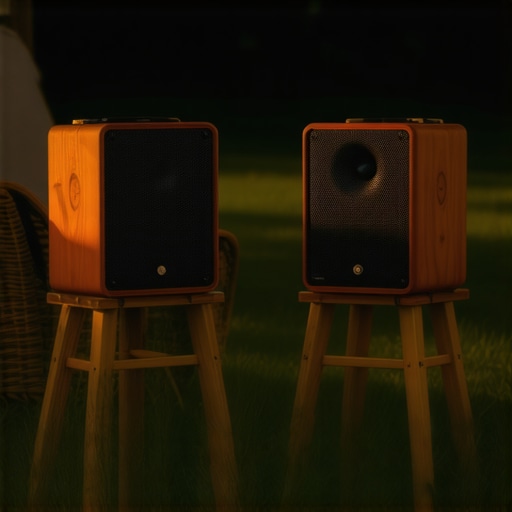 If you are sitting six feet away, the speakers should be six feet apart. This mirrors the professional logic used in studios, much like how to find the sweet spot for your speakers in a rectangular room. If you place them too close, you’re just listening to expensive mono. Too far apart, and you get a hole in the middle of the soundstage where the vocals should be.
Stop the Stutter Before the Party Starts
Wireless interference is the silent killer of TWS setups. Every modern home is a minefield of 2.4GHz signals from routers and microwaves. If your audio starts cutting out, it’s usually because the link between the two speakers is being crowded. This is very similar to why your bluetooth headphones stutter when your phone is in your pocket—the signal is being blocked by physical or electromagnetic barriers. Always try to maintain a clear line of sight between the two speakers. Even a heavy wooden table or a human body standing in the way can cause the right channel to lag behind the left. I’ve even seen people struggle because they used cheap stands that rattled; in those cases, the vibration can actually affect the internal components, which is why the reason your speaker stands need to be filled with sand is such a common piece of advice for high-end setups—it grounds the sound and prevents mechanical interference from messing with the wireless receiver. Always ensure your primary speaker is the one closest to your playback device to minimize the workload on the internal Bluetooth chip.A common mistake I see is people obsessing over the source file quality while ignoring the physical limitations of their hardware. You might be playing a 24-bit FLAC file, but if your TWS setup is using a standard SBC codec, you’re essentially trying to pour a gallon of water through a needle. This is exactly why your high-end DAC sounds exactly like your laptops headphone jack when you are dealing with bottlenecked wireless streams. I have had friends spend more on a portable DAC than they did on the speakers themselves, which is a massive trap. Instead of buying gear to fix the signal, you should be looking at the amplifier’s headroom. Most people do not realize that why your bookshelf speakers need more power than you think is because the dynamic peaks in music—like a sudden drum hit—can require ten times the average power. If your amp cannot provide that, it clips, and you lose that life in the music.
Don’t Starve Your Drivers of Clean Power
Another trap is the assumption that if it is loud enough, it is good enough. This is where how to tell if your amplifier has enough headroom for your speakers becomes a vital skill. When an amp runs out of steam, it does not just stop getting louder; it starts distorting the waveform, which can actually heat up your voice coils and cause permanent damage. If you are pushing a TWS pair to its limits, you are often stressing the master speaker’s battery and processor simultaneously. This leads to a loss of detail that no high-end cable can fix. In fact, why cheap speaker wire causes signal loss over 50 feet is a real concern for wired setups, but for TWS, the wire is a radio frequency that is equally prone to degradation. 
Is your wireless link actually the bottleneck for your audio quality?
Research conducted by Dr. Sean Olive at Harman International has shown that listeners consistently rank spatial attributes—like the width and depth of the soundstage—higher than minute differences in file resolution. This confirms what I have always felt: two budget speakers in a proper TWS configuration will almost always beat one flagship speaker in mono because of that spatial data. But you have to maintain the health of that link over the long haul. Over time, internal components can age, and knowing how to tell if your speakers capacitor is starting to fail can save you from a complete hardware collapse. Have you ever fallen into the more expensive is better trap only to be disappointed by the actual sound? Let me know in the comments.
Keep Your Gear Alive Past the One-Year Mark
I have seen way too many great portable setups end up in a junk drawer because of poor battery habits. I used to be the guy who grabbed whatever USB-C cable was lying around the kitchen, but I eventually learned the truth about using a fast charger for your portable speaker. Most of these units aren’t designed for 65W laptop bricks, and over-volting them is a fast track to finding out why your portable speaker is losing its charge faster than usual. If you want your TWS pair to last, use the rated power brick and keep them between 20% and 80% charge. Heat is the ultimate enemy of the internal lithium cells and the DSP chips that handle the stereo handshake.
How do I maintain my TWS setup over time?
Maintenance isn’t just about the battery; it’s about the physical connections and the drivers themselves. Every few months, I take a soft brush to the ports. You would be shocked at how much pocket lint gets in there, which is why I wrote a guide on how to clean dust out of your headphone jack without damaging pins, a logic that applies to charging ports too. If you live in a humid climate, the rubber bits can get nasty. Knowing how to clean sticky speaker surrounds without damaging the rubber will keep the cone moving freely. If you do spot a tiny tear from an accidental drop during a party, don’t panic; how to fix a small rip in a speaker surround with glue is a lifesaver that keeps the enclosure airtight and the bass punchy. [image_placeholder_d]
Scale Your System Without Buying New Speakers
Once you’ve mastered the TWS pair, you might find yourself wanting even more range. Sometimes, the built-in Bluetooth antenna just isn’t enough for a large backyard. I’ve personally experimented with how to add an external antenna to a bluetooth receiver for better range to push my master signal further. However, as you scale, you have to be vigilant about hardware health. If one speaker starts sounding thinner than the other, you might be how to spot a blown-tweeter before it ruins your crossover. I use a can of DeoxIT and how to fix a scratchy volume dial with electrical contact cleaner whenever my older units start acting up. According to technical documentation from the Bluetooth Special Interest Group (SIG) regarding LE Audio, the future of TWS lies in the LC3 codec, which will allow for even more devices to sync with lower latency. For now, we are at the mercy of our current hardware’s processing power. I want you to try one thing this weekend: perform the simple paper test for finding air leaks in your speaker cabinet. It takes two minutes and reveals more about your speaker’s physical health than any software ever could.
Hard Lessons from My Years of Wireless Audio Experiments
After years of testing various setups, the biggest lightbulb moment I had was realizing that human bodies are essentially giant bags of water that absorb 2.4GHz signals. If you are at a party and the music starts skipping, it is likely because someone is standing directly between your Master and Slave units. I also learned that environment dictates performance more than the price tag; even why your soundbar sounds tiny in a vaulted ceiling room is often just a matter of physics that you can counteract with smarter placement. Lastly, I discovered that more volume does not equal more quality. If you find yourself constantly cranking it up just to hear the details, you probably have a placement or stereo imaging issue rather than a lack of power.
The Tools and Habits I Swear By
When I want to truly test a new setup without interruptions, I never use my primary phone which is constantly pinging with notifications. I have found that how to use an old phone as a dedicated high-res music player is the best way to keep the stream stable and save your main phone’s battery. I also keep a physical tape measure handy to ensure my speakers are exactly the same distance from my primary seat; this is the most reliable way how to get better stereo separation in a very narrow room can be achieved. For long-term health, I recommend a dedicated low-voltage charging station and a simple microfiber cloth to keep the drivers and ports clear of debris.
Your Journey to Better Sound Starts Now
You do not need a degree in acoustics to make your backyard sound like a professional concert hall. You just need a little patience and the willingness to experiment with your True Wireless Stereo configuration until it clicks. Whether you are using high-end units or budget-friendly pairs, the principles of physics remain the same. Even if you have just unboxed your gear today, it is worth learning how to properly break-in new headphones without using white noise and applying those same gentle ‘soft-start’ concepts to your new speakers to ensure the drivers settle in perfectly. Now, get out there, grab your gear, and start building that wall of sound!
Have you ever had a TWS setup that worked perfectly in your living room but completely fell apart once you took it outside? Let me know in the comments below!